
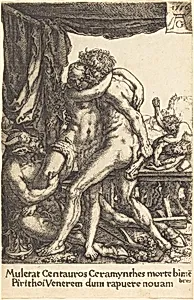
Hercules Preventing the Centaurs from the Rape of Hippodamia
Classification
Department
CG-E
Museum
National Gallery of Art, Washington, D.C.
Credit
Rosenwald Collection
Accession Number
1943.3.258
Rights
Public Domain
Art Historical Context
In the National Gallery of Art's Rosen Collection, Heinrich Aldegrever's 1550 print *Hercules Preventing theaurs from the Rape Hippodamia* captures dramatic moment from Greek mythology. The scene depicts the mighty hero Hercules intervening during the chaotic wedding feast of Pirithous and Hippod, where drunken centaurs attempt to abduct the bride and Lapith women. Aldegre, a German engraver from Soest active in the Northern Renaissance, masterfully conveys the frenzy of combat through dynamic figures locked in struggle. As one of the "Little Masters"—printmakers renowned for their intricate small-scale works—Aldegrever drew inspiration from classical antiquity and predecessors like Albrecht Dürer. Created around 1550, amid the Renaissance revival of pagan myths, this print reflects humanism's fascination with heroic virtue and moral order triumphing over barbarism. Prints like this were revolutionary, enabling affordable dissemination of sophisticated imagery to collectors and scholars across Europe. Though the exact medium remains unspecified, its classification as a print underscores its technical precision and cultural role. Visitors will appreciate how Aldegrever's detailed linework brings ancient legend to life, inviting reflection on timeless themes of civilization versus chaos. (198 words)
About the Artist
Heinrich Aldegrever · 1502–1561
Heinrich Aldegrever, born in 1502 in Paderborn, Westphalia, to parents Herman and Katherine Trippenmeker—a family of clog-makers known by the dialect name Trippenmecker—emerged as a multifaceted artist in the German Renaissance. His early training remains undocumented, though he likely apprenticed in a Soest goldsmith's workshop after relocating there around 1525, where he joined the painters' gui...