
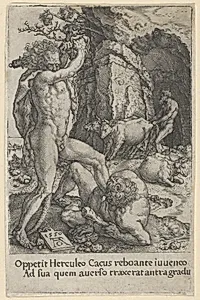
Hercules Killing Cacus, from The Labors of Hercules
Medium
Engraving
Dimensions
Sheet: 4 3/16 × 2 3/4 in. (10.7 × 7 cm)
Classification
Prints
Department
Drawings and Prints
Museum
Metropolitan Museum of Art, New York, NY
Credit
Gift of Felix M. Warburg and his family, 1941
Accession Number
41.1.113
Rights
Public Domain
Tags
Art Historical Context
In the bustling world of 16th-century Northern Renaissancemaking, Heinrich Aldegver, a master engraver from Soest, Germany, crafted *Hercules Killing C* around 1550. Part of his series *The Labors Hercules*, this tiny engraving (just 4 3/16 × 2 3/4 inches) the mythical hero's third with remarkable precision. Aldegre, one of the "Little Masters celebrated for their intricate small-scale works, drew from classical sources like Ovid to depict Hercules slaying the fire-breathing giant Cacus, who had stolen the demigod's prized cattle and dragged them tail-first into his cave to confuse the trail. Engraving's fine lines allowed Aldegrever to pack dynamic action—muscular struggle, twisting forms, and dramatic tension—into a format small enough for collectors' albums or personal study. This technique, using a burin to incise metal plates, produced rich tonal contrasts and exquisite detail, making prints like this affordable vehicles for humanist ideals, blending pagan mythology with Renaissance virtuosity. Today, housed in the Metropolitan Museum of Art's Drawings and Prints department (gift of Felix M. Warburg and family, 1941), it reflects the era's fascination with heroic antiquity amid religious upheavals, inviting visitors to marvel at how a miniature image embodies epic strength and artistic ingenuity.
About the Artist
Heinrich Aldegrever · 1502–1561
Heinrich Aldegrever, born in 1502 in Paderborn, Westphalia, to parents Herman and Katherine Trippenmeker—a family of clog-makers known by the dialect name Trippenmecker—emerged as a multifaceted artist in the German Renaissance. His early training remains undocumented, though he likely apprenticed in a Soest goldsmith's workshop after relocating there around 1525, where he joined the painters' gui...