
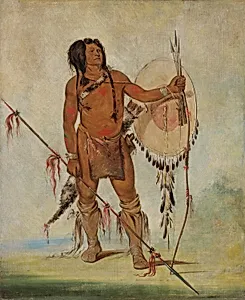
His-oo-sán-chees, Little Spaniard, a Warrior
1834
Medium
Painting
Classification
Painting
Department
Smithsonian Collection
Museum
Smithsonian American Art Museum
Credit
Smithsonian American Art Museum, Gift of Mrs. Joseph Harrison, Jr.
Accession Number
1985.66.51
Rights
Public Domain
Tags
About this artwork
George Catlin painted Little Spaniard at the Comanche village in 1834. Impressed with the Comanche warrior, he later wrote of Little Spaniard as “A gallant little fellow . . . represented to us as one of the leading warriors of the tribe; and no doubt . . . one of the most extraordinary men at present living in these regions. He is half Spanish, and being a half-breed, for whom they generally have the most contemptuous feelings, he has been all his life thrown into the front of battle and danger...
Art Historical Context
George Catlin's *His-oo-sán-chees, Little Spani, a Warrior* (1834) captures a remarkable Comanche leader during the artist's ambitious journey to document Native American tribes across Great Plains. Painted on-site at a Comanche, this full-length oil portrait exemplifies Catlin's to preserving the likenesses and cultures of Indigenous peoples amid rapid encroachment by American settlers. As a pioneering figure in 19th-century American art, Catlin's realistic style emphasized ethnographic accuracy, blending portraiture with cultural observation to create vivid records of a vanishing way of life. The subject, His-oo-sán-chees—nicknamed "Little Spaniard" for his half-Spanish heritage—stands poised with his shield on one arm, quiver slung over his shoulder, and a towering 14-foot lance in hand. Despite facing prejudice as a half-breed, he rose to prominence as a daring warrior, admired for his bone-and-muscle physique, agility, and bravery. Catlin recounts how this "gallant little fellow" boldly approached his party under a white flag, showcasing both warrior prowess and gentlemanly politeness. This painting holds enduring historical and cultural significance, offering a window into Comanche traditions—from intricate Indian dress to symbols of combat like the spear and shield—while highlighting themes of resilience and cross-cultural encounter in the early 19th-century frontier.
About the Artist
George Catlin · 1796–1872
George Catlin (1796–1872), born in Wilkes-Barre, Pennsylvania, to Putnam Catlin and Polly Sutton—who had been captured by Native Americans during the 1778 Battle of Wyoming—initially pursued a legal career. Trained at Litchfield Law School, he was admitted to the bar in 1819 but abandoned law after two years to study art in Philadelphia in 1823. Self-taught as a portraitist, Catlin quickly gained ...