
Is-sa-wáh-tám-ah, Wolf Tied with Hair, a Chief
1834
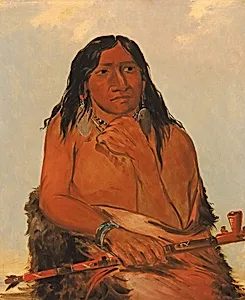
Medium
Painting
Classification
Painting
Department
Smithsonian Collection
Museum
Smithsonian American Art Museum
Credit
Smithsonian American Art Museum, Gift of Mrs. Joseph Harrison, Jr.
Accession Number
1985.66.50
Rights
Public Domain
Tags
About this artwork
George Catlin described the subject as holding a “pipe in his hand,” and went on to detail the intricate ritual of pipe-smoking among Native Americans: “As smoking is a luxury so highly valued by the Indians, they have bestowed much pains, and not a little ingenuity, to the construction of their pipes. Of these I have procured a collection of several hundreds, and have given facsimile outlines of a number of the most curious. The bowls of these are generally made of the red steatite, or ‘pipe-st...
Art Historical Context
**Is-sa-wáh-tám-ah, Wolf Tied with, a Chief** (1834) is a compelling portrait by George Catlin the pioneering 19th-century American artist dedicated to documenting Native American cultures. Painted on-site at a Comanche during Catlin's extensive travels across the Great Plains, this oil painting captures the dignified presence of a Comanche chief, embodying the artist's mission to record indigenous life before rapid Western expansion altered it forever. Central to the portrait is the chief's pipe, a symbol of profound cultural ritual. Catlin, fascinated by Native American customs, noted the "highly valued" art of pipe-smoking, where intricately carved pipes—often from sacred red pipestone (steatite)—featured elaborate relief figures. He amassed hundreds of these artifacts, highlighting their ingenious design and the solemn ceremonies they facilitated, from treaties to spiritual invocations. This work, now in the Smithsonian American Art Museum, exemplifies Catlin's ethnographic realism, blending portraiture with cultural advocacy. It offers visitors a vivid window into Comanche heritage and the vanishing traditions Catlin sought to immortalize.
About the Artist
George Catlin · 1796–1872
George Catlin (1796–1872), born in Wilkes-Barre, Pennsylvania, to Putnam Catlin and Polly Sutton—who had been captured by Native Americans during the 1778 Battle of Wyoming—initially pursued a legal career. Trained at Litchfield Law School, he was admitted to the bar in 1819 but abandoned law after two years to study art in Philadelphia in 1823. Self-taught as a portraitist, Catlin quickly gained ...