
Italian
1906
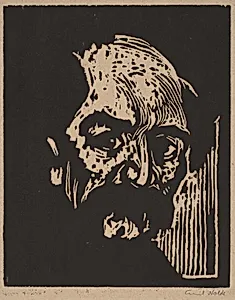
Medium
woodcut on laid buff paper
Dimensions
plate: 28.8 × 23 cm (11 5/16 × 9 1/16 in.) sheet: 35.2 × 30.3 cm (13 7/8 × 11 15/16 in.)
Classification
Department
CG-W
Museum
National Gallery of Art, Washington, D.C.
Credit
Gift of Ruth Cole Kainen
Accession Number
2012.92.416
Rights
Public Domain
Art Historical Context
Emil Nolde's *Italian* (1906) is a striking woodcut print on laid buff paper, capturing artist's early fascination with bold, expressive forms. Measuring 28.8 × 23 cm on the plate, this work exemplifies Nolde's transition toward German Expressionism. As a founding member of the Die Br group shortly after this piece, Nolde drew inspiration from folk art, primitive carvings, and non-Western influences, infusing his prints with raw emotional intensity and simplified contours. Woodcuts, a demanding relief printing technique, allowed Nolde to achieve dramatic contrasts and textured lines by carving directly into wood blocks. This medium's significance lies in its accessibility and directness, echoing medieval traditions while pushing modern boundaries. Printed on warm buff paper, *Italian* likely evokes a portrait or figure from Nolde's travels or imagination, highlighting his interest in human vitality amid early 20th-century artistic upheaval. Housed in the National Gallery of Art's print collection through the generous gift of Ruth Cole Kainen (Department CG-W), this piece offers visitors a window into Nolde's innovative printmaking, bridging symbolism and the explosive energy of Expressionism. A testament to his lifelong passion for color and emotion, even in monochrome.
About the Artist
Emil Nolde · 1867–1956
Emil Nolde, born Hans Emil Hansen on August 7, 1867, near the village of Nolde in what was then Prussian Schleswig (now Denmark), grew up on a farm amid devout Protestant Danish and Frisian peasant parents. The youngest of four brothers, he apprenticed as a woodcarver and illustrator in Flensburg from 1884 to 1891, working in furniture factories before studying at the School of Applied Arts in Kar...