
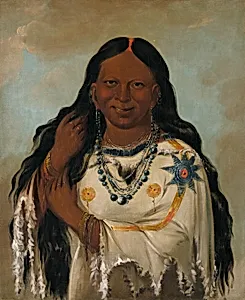
Kay-a-gís-gis, a Young Woman
1832
Medium
Painting
Classification
Painting
Department
Smithsonian Collection
Museum
Smithsonian American Art Museum
Credit
Smithsonian American Art Museum, Gift of Mrs. Joseph Harrison, Jr.
Accession Number
1985.66.183
Rights
Public Domain
Tags
About this artwork
George Catlin described Kay-a-gís-gis as “a beautiful young woman pulling her hair out of braid.” Catlin painted this portrait at Fort Union in the upper Midwest in 1832, and it was one of his first attempts to show facial expression. The woman’s smile, somewhat forced, but engagingly shy and self-conscious, is an indication of the artist's growing perception of individual qualities among subjects whose appearance had not been critically examined before. (Truettner, The Natural Man Observed, 197...
Art Historical Context
In 1832, pioneering artist George Catlin painted *Kay-a-gis-gis, a Young* at Fort Union, a fur-trading post in the upper Midwest. intimate bust portrait captures an Ojibwa woman in traditional Indian dress, as Catlin himself described her: "a beautiful young woman pulling hair out of braid." of Catlin's early from his ambitious project to document Native American life culture before it vanished under Western expansion, it reflects his time among Indigenous peoples during a period of rapid change. Artistically, the painting marks a breakthrough for Catlin, who was honing his ability to convey facial expressions. Kay-a-gis-gis's smile—forced yet shy and self-conscious—reveals his emerging sensitivity to individual personalities, challenging the era's stereotypical views of Native Americans as mere "types." As a Romantic-era portraitist, Catlin blended realism with empathy, using oil paints to highlight her features and attire with vivid detail. Housed in the Smithsonian American Art Museum, this work underscores the cultural importance of preserving Indigenous identities through art. It invites viewers to see beyond the exotic, connecting us to a young woman's quiet humanity amid 19th-century America's turbulent frontier. (198 words)
About the Artist
George Catlin · 1796–1872
George Catlin (1796–1872), born in Wilkes-Barre, Pennsylvania, to Putnam Catlin and Polly Sutton—who had been captured by Native Americans during the 1778 Battle of Wyoming—initially pursued a legal career. Trained at Litchfield Law School, he was admitted to the bar in 1819 but abandoned law after two years to study art in Philadelphia in 1823. Self-taught as a portraitist, Catlin quickly gained ...