
Kay-ée-qua-da-kúm-ee-gísh-kum, He Who Tries the Ground with His Foot
1836
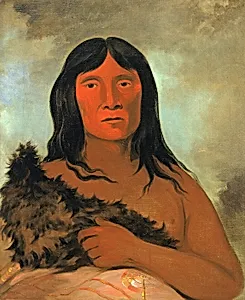
Medium
Painting
Classification
Painting
Department
Smithsonian Collection
Museum
Smithsonian American Art Museum
Credit
Smithsonian American Art Museum, Gift of Mrs. Joseph Harrison, Jr.
Accession Number
1985.66.185
Rights
Public Domain
Tags
About this artwork
In 1835, after his visit to Oklahoma, George Catlin journeyed up the Mississippi by steamer from New Orleans to Fort Snelling in present-day Minnesota, bringing his wife, Clara, on a western “tour” for the first and only time. Tribes of the Upper Mississippi and Great Lakes region, such as the Ojibwe/Chippewa shown here, had been increasingly pressured by European traders, war, and United States expansion since the eighteenth century. Well before Catlin’s arrival, the upper midwestern tribes had...
Art Historical Context
George Catlin's 1836 portrait *Kay-é-e-qua-da-kúm-ee-gísh-kum, He Who T the Ground with His Foot captures an Ojibwe (Chippewa) man from Upper Mississippi and Great Lakes region. Painted during Catlin's ambitious mission to document Native American life, this oil painting exemplifies his realistic style, blending Romantic admiration for indigenous peoples with precise ethnographic detail. As a pioneering artist-ethnographer, Catlin created hundreds of such portraits in the 1830s, preserving vanishing cultures amid rapid change. In 1835, Catlin traveled up the Mississippi by steamer from New Orleans to Fort Snelling (modern Minnesota), accompanied by his wife Clara on their only western "tour." By then, Ojibwe communities had endured centuries of pressure from European traders, intertribal wars, and U.S. expansion. Notably, the sitter's attire reflects cultural adaptation: traditional elements fused with woven cloth and intricate beadwork acquired through trade. This work, now in the Smithsonian American Art Museum (gift of Mrs. Joseph Harrison, Jr.), highlights the resilience of Ojibwe identity while underscoring Catlin's urgent role in visual history—offering museum visitors a poignant window into a transformative era.
About the Artist
George Catlin · 1796–1872
George Catlin (1796–1872), born in Wilkes-Barre, Pennsylvania, to Putnam Catlin and Polly Sutton—who had been captured by Native Americans during the 1778 Battle of Wyoming—initially pursued a legal career. Trained at Litchfield Law School, he was admitted to the bar in 1819 but abandoned law after two years to study art in Philadelphia in 1823. Self-taught as a portraitist, Catlin quickly gained ...