
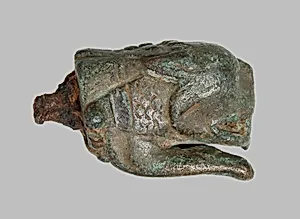
Key Handle
Unknown Artist
1st–7th century
Medium
Copper alloy, iron
Dimensions
Overall: 1 3/4 x 13/16 x 1 1/8 in. (4.5 x 2 x 2.8 cm)
Classification
Metalwork-Copper alloy
Culture
Roman
Department
Medieval Art
Museum
Metropolitan Museum of Art, New York, NY
Credit
Purchase, De Souhami Collection, Rogers Fund, 1906
Accession Number
06.176.33
Rights
Public Domain
Art Historical Context
This delicate **Key Handle**, crafted from copper alloy and iron during the 1st–7th century, exemplifies the everyday artistry of Roman metalwork. Measuring just 1¾ x 13/16 x 1⅛ inches, its petite scale suggests it belonged to a personal or household lock, a common necessity in the bustling Roman world where property security was paramount. Acquired by The Metropolitan Museum of Art in1906 through the Rogers Fund and De Souhami Collection, now resides in the Medieval Art department bridging late antiquity and early medieval craftsmanship. In Roman culture, keys were more than utilitarian—they symbolized authority, privacy, and trust, often carried by women as a sign of household management. This handle's copper alloy, likely bronze, offered durability and a subtle sheen, while the iron core provided strength. Artisans employed lost-wax casting or hammering techniques to shape its precise form, showcasing the technical prowess of Roman workshops that produced everything from grand statues to intimate tools. Though the artist remains unknown, this artifact whispers of daily life across the Roman Empire's vast reach, from villas to frontier forts. A testament to functional beauty, it invites us to ponder the hands that once gripped it, unlocking secrets of the ancient past.