
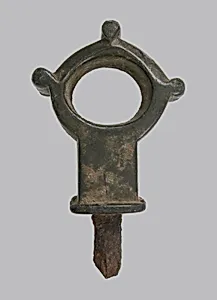
Key-Handle
Unknown Artist
1st–7th century
Medium
Copper alloy, iron
Dimensions
Overall: 3 3/16 x 1 7/8 x 1 1/16 in. (8.1 x 4.8 x 2.7 cm)
Classification
Metalwork-Copper alloy
Culture
Roman
Department
Medieval Art
Museum
Metropolitan Museum of Art, New York, NY
Credit
Purchase, De Souhami Collection, Rogers Fund, 1906
Accession Number
06.176.2
Rights
Public Domain
Art Historical Context
This exquisite *Key-Handle* from the Roman world, dating to the 1st–7th century CE, exemplifies the craftsmanship of late antiquity. Crafted from copper alloy with iron elements, it measures a compact 3 3/16 x 1 7/8 x 1 1/16 inches, designed to fit comfortably in the hand. Acquired by The Metropolitan Museum of Art in 1906 through the De Souhami Collection and Rogers Fund, it resides in the Medieval Art department, bridging Roman and early medieval traditions. In Roman society, keys were more than utilitarian tools—they symbolized authority, household management, and even divine access in temples. This handle, classified as copper alloy metalwork, likely features intricate casting techniques typical of the era, where alloys provided durability and a lustrous finish resistant to corrosion. The iron component suggests a composite construction, blending the strength of iron for the functional shank with the malleability of copper alloy for decorative flair. Though the artist's identity is lost to time, the object's survival highlights the enduring skill of Roman artisans. For visitors, it offers a tangible glimpse into daily life across centuries, reminding us how everyday objects carried profound cultural weight in an empire spanning from pagan rituals to Christian emergence.