
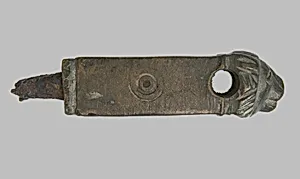
Key Handle
Unknown Artist
1st–7th century
Medium
Copper alloy, iron
Dimensions
Overall: 2 5/8 x 5/8 x 5/8 in. (6.6 x 1.6 x 1.6 cm)
Classification
Metalwork-Copper alloy
Culture
Roman
Department
Medieval Art
Museum
Metropolitan Museum of Art, New York, NY
Credit
Purchase, De Souhami Collection, Rogers Fund, 1906
Accession Number
06.176.14
Rights
Public Domain
Art Historical Context
This exquisite *Key Handle* from the world, dating to the 1st–7th century CE, offers a glimpse into everyday ingenuity of late antiquity. Crafted from copper alloy iron elements, it measures compact 2 5/8 x 5/8 x5/8 inches, making it suited for personal use. Acquired The Metropolitan Museum of Art in1906 through the Dehami Collection and Rogers, it resides in the Art department, bridging Roman craftsmanship with early medieval. Roman metalworkers excelled in casting and forging durable alloys like copperoften bronze—for functional objects, ensuring both strength and portability. This handle exemplifies their skill, where the combination of copper alloy's corrosion resistance and iron's robustness allowed for intricate, long-lasting designs. Keys held practical and symbolic importance in Roman society, securing homes, tombs, and treasures, and their handles were sometimes adorned to reflect status or beliefs. Though the artist's identity is lost to time, this artifact highlights the artistry in utilitarian metalwork, reminding us how ordinary tools embodied cultural values. A testament to Roman engineering, it invites visitors to ponder the hands that once gripped it across centuries.