
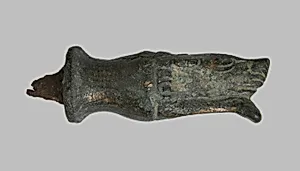
Key Handle
Unknown Artist
1st–7th century
Medium
Copper alloy, iron
Dimensions
Overall: 2 9/16 x 13/16 in. (6.5 x 2.1 cm)
Classification
Metalwork-Copper alloy
Culture
Roman
Department
Medieval Art
Museum
Metropolitan Museum of Art, New York, NY
Credit
Purchase, De Souhami Collection, Rogers Fund, 1906
Accession Number
06.176.30
Rights
Public Domain
Art Historical Context
This exquisite *Key Handle*, crafted from copper alloy and iron by an unknown Roman artisan between the 1st and 7th centuries, offers a glimpse into the everyday ingenuity of the ancient world. Measuring just 2 9/16 x 13/16 inches (6.5 x 2.1 cm), its compact form belies its practical purpose: likely part of a larger key used to secure doors, chests, or sacred spaces in Roman households and temples. Displayed in the Medieval Art department of the Metropolitan of Art—acquired in 1906 through the Souhami Collection and Fund—this artifact bridges the late Roman Empire and early medieval periods. Roman metalworkers excelled in copper alloys, akin to bronze, valued for their durability, corrosion resistance, and ability to hold fine details when cast or hammered. The inclusion of iron suggests a composite construction, enhancing strength for functional use while allowing decorative flourishes on the handle. Such objects were more than mere tools; keys symbolized authority, privacy, and trust in a society where locks protected valuables amid expanding trade and urban life. Though modest in scale, this key handle reveals the artistry in Roman utilitarian metalwork, reminding us how ordinary items carried profound cultural weight—from domestic security to ritual guardianship. A testament to enduring craftsmanship, it invites visitors to ponder the hands that once gripped it.