
Knife (Korambi) with Sheath
Unknown Artist
18th–19th century
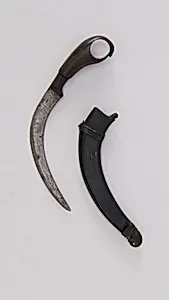
Medium
Bone, wood, steel
Dimensions
H. with sheath 6 1/4 in. (15.9 cm); H. without sheath 5 3/4 in. (14.6 cm); W. 1 1/4 in. (3.2 cm); Wt. 2 oz. (56.7 g); Wt. of sheath 0.7 oz. (19.8 g)
Classification
Knives
Culture
Malayan (possibly Sulawesi)
Department
Arms and Armor
Museum
Metropolitan Museum of Art, New York, NY
Credit
Bequest of George C. Stone, 1935
Accession Number
36.25.823a, b
Rights
Public Domain
Art Historical Context
This compact Knife (Korambi) Sheath, dating to the 18th–19th century, originates from Malayan culture—possibly Sulawesi in present-day Indonesia. Measuring just 6¼ inches (15.9 cm) tall with its sheath and weighing a mere 2.7 ounces total, it represents the practical yet elegantly crafted edged weapons carried by individuals in Southeast Asian societies. Such knives were essential tools for daily tasks, self-defense, or ceremonial use, reflecting the region's martial traditions amid trade, migration, and tribal conflicts. Forged from steel for the blade, with a handle of bone and wood, the korambi showcases resourceful material choices that balanced durability and comfort. The lightweight sheath, at 0.7 ounces, protected the 5¾-inch blade during transport, underscoring the object's portability. These natural materials often allowed for subtle decorative work, highlighting the artisan's skill in blending form and function. Housed in The Metropolitan Museum of Art's Arms and Armor Department through the 1935 bequest of collector George C. Stone, this piece offers a window into Malayan craftsmanship. It invites us to appreciate how everyday objects embodied cultural identity and survival in a vibrant, island archipelago world.