
Landscape Background
1846-1848
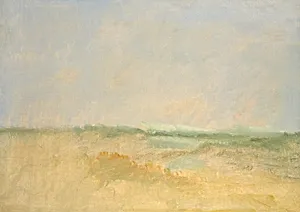
Medium
Painting
Classification
Painting
Department
Smithsonian Collection
Museum
Smithsonian American Art Museum
Credit
Smithsonian American Art Museum, Gift of Mrs. Joseph Harrison, Jr.
Accession Number
1985.66.589-U
Rights
Public Domain
Tags
About this artwork
“The landscape scenes of these wild and beautiful regions, are, of themselves, a rich reward for the traveler.” (Catlin, Letters and Notes, vol. 2, no. 37, 1841; reprint 1973)
Art Historical Context
George Catlin's *Landscape Background* (184–1848) captures the vast, untamed beauty of the American West during a pivotal era of exploration and expansion. As a pioneering artist and ethnographer, Catlin traveled through the Great Plains and Rocky Mountains in the 183s and 1840s, documenting Native life and the dramatic landscapes that framed it. This oil painting, now in the Smithsonian American Art Museum likely served as a backdrop for his renowned portraits of Indigenous peoples, blending scenic grandeur with cultural portraiture in his traveling "Indian Gallery." Catlin's realistic style, rooted in 19th-century American landscape painting, emphasizes the sublime wilderness he so admired. He wrote in his *Letters and Notes* (1841): “The landscape scenes of these wild and beautiful regions, are, of themselves, a rich reward for the traveler.” This work reflects that passion, portraying rugged terrains that symbolized both opportunity and impending change amid westward migration. Housed in the Smithsonian's collection through a generous gift, *Landscape Background* stands as a testament to Catlin's urgent mission to preserve vanishing frontiers. For visitors, it evokes the awe of early American discovery, inviting reflection on nature's enduring allure and the artist's role as visual chronicler.
About the Artist
George Catlin · 1796–1872
George Catlin (1796–1872), born in Wilkes-Barre, Pennsylvania, to Putnam Catlin and Polly Sutton—who had been captured by Native Americans during the 1778 Battle of Wyoming—initially pursued a legal career. Trained at Litchfield Law School, he was admitted to the bar in 1819 but abandoned law after two years to study art in Philadelphia in 1823. Self-taught as a portraitist, Catlin quickly gained ...