
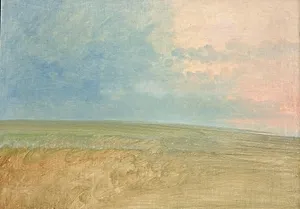
Landscape Background
1846-1848
Medium
Painting
Classification
Painting
Department
Smithsonian Collection
Museum
Smithsonian American Art Museum
Credit
Smithsonian American Art Museum, Gift of Mrs. Joseph Harrison, Jr.
Accession Number
1985.66.596-U
Rights
Public Domain
Tags
About this artwork
“The landscape scenes of these wild and beautiful regions, are, of themselves, a rich reward for the traveler.” (Catlin, Letters and Notes, vol. 2, no. 37, 1841; reprint 1973)
Art Historical Context
George Catlin’s “Landscape Background,” painted between 1846 and 1848, captures the vast, untamed beauty of the American West during a period of rapid territorial expansion. As an artist-explorer, Catlin traveled extensively through the Great Plains and beyond in the 1830s, creating hundreds of works that documented both Native peoples and the natural environments they inhabited. This painting reflects his deep appreciation for these regions, which he viewed as both inspiring and endangered by encroaching settlement. The work’s title suggests it may have served as a scenic backdrop, possibly within Catlin’s celebrated Indian Gallery exhibitions that brought Western imagery to Eastern and European audiences. His landscapes often emphasized the dramatic scale and pristine quality of the terrain, aligning with his written observation that “the landscape scenes of these wild and beautiful regions, are, of themselves, a rich reward for the traveler.” Through his straightforward, documentary approach, Catlin helped shape early visual understandings of the American frontier. Now part of the Smithsonian American Art Museum’s collection, the painting stands as both an artistic record and a historical artifact of 19th-century exploration. It invites viewers to consider how artists like Catlin preserved fleeting impressions of landscapes that would soon be transformed.
About the Artist
George Catlin · 1796–1872
George Catlin (1796–1872), born in Wilkes-Barre, Pennsylvania, to Putnam Catlin and Polly Sutton—who had been captured by Native Americans during the 1778 Battle of Wyoming—initially pursued a legal career. Trained at Litchfield Law School, he was admitted to the bar in 1819 but abandoned law after two years to study art in Philadelphia in 1823. Self-taught as a portraitist, Catlin quickly gained ...