
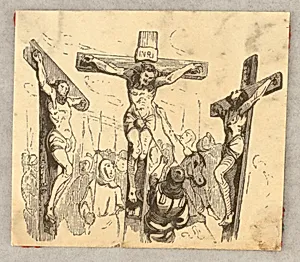
Longinus Piercing the Side of Christ
1840s
Classification
Department
Smithsonian Collection
Museum
Smithsonian American Art Museum
Credit
Smithsonian American Art Museum
Accession Number
1945-200-477
Rights
Public Domain
About this artwork
Research in Progress
Art Historical Context
"Longinus Piercing the of Christ," a print from the 1840s housed in the Smithsonian American Art Museum, captures a dramatic moment from the Crucifixion narrative in Christian tradition. The unknown artist depicts the Roman centurion Longinus, traditionally identified as the soldier who pierced' side with a lance to confirm his death, as recounted in the Gospel of John. This scene, rich in symbolism, represents themes of redemption and divine mercy—legend holds that Long was healed of blindness by Christ's blood, leading to his conversion. Created during the mid-19th century, a period of fervent religious revivalism in America known as the Second Great Awakening, this print reflects the era's demand for accessible devotional imagery. Prints were a vital medium then, allowing widespread reproduction and distribution of sacred art through techniques like engraving or lithography, making profound biblical stories available to households beyond elite patrons. Though research on this specific work is ongoing, its presence in the Smithsonian Collection underscores its value as a window into 19th-century American religious culture. Visitors can ponder how such prints fostered personal piety and community faith, bridging art and spirituality in everyday life.
About the Artist
Unknown
The artist designated as "Unknown" in our virtual museum's collection exemplifies a poignant chapter in art history: creators whose identities have faded into obscurity despite the enduring power of their work. With only one known artwork attributed to them in our holdings, this figure represents countless anonymous hands that shaped visual culture across centuries. Museums worldwide, including th...