
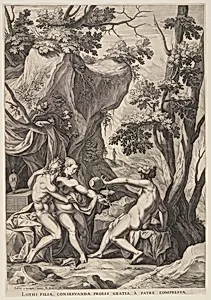
Lot and His Daughters
c. 1580-1600
Medium
Engraving on ivory laid paper
Dimensions
Sheet (trimmed): 41.5 × 28.9 cm (16 3/8 × 11 7/16 in.)
Classification
Department
Prints and Drawings
Museum
Art Institute of Chicago
Accession Number
268709
Rights
Public Domain
About this artwork
This scene illustrates an episode from the Old Testament book of Genesis. After fleeing the destruction of Sodom, Lot and his daughters took refuge in a cave. Realizing there were no men left to continue their lineage, the daughters decided to get their father drunk and have sex with him without him realizing. The story was very popular in the Renaissance: it allowed artists to depict a sexual subject while also warning against the dangers of wantonness and seduction.
Art Historical Context
In the Prints and Drawings department of the Institute of Chicago hangs an evocative engraving titled *Lot and His Daughters* by Raphael Sadeler I, around 1580-1600. This trimmed sheet, measuring 41.5 × 28.9 cm and printed on fine ivory laid paper, captures a dramatic biblical scene from Genesis 19. It depicts Lot, the righteous man spared from Sodom's destruction, in a compromising moment with his two daughters, who—believing humanity extinct—offer him wine to ensure their lineage's survival. Sadeler, a Flemish engraver from a renowned family of printmakers based in Antwerp and later Prague, masterfully translates this morally charged narrative into intricate lines. Engraving, Sadeler's chosen medium, was a revolutionary technique in the late Renaissance, allowing detailed reproductions of paintings to reach a wide audience across Europe. His precise burin work on the copper plate creates rich tonal contrasts and textures, from the lush drapery to the figures' expressive poses, reflecting Mannerist influences with elongated forms and emotional intensity. Ivory laid paper, prized for its smooth surface and subtle chain lines, enhances the print's luminosity and durability. This artwork not only illustrates a timeless tale of survival and taboo but also highlights prints' cultural role in disseminating religious stories during the Counter-Reformation era. Sadeler's piece invites visitors to ponder the blurred lines between virtue and desperation in human nature.