
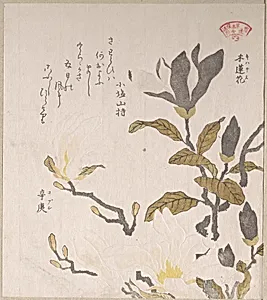
Magnolia Flowers
19th century
Medium
Part of an album of woodblock prints (surimono); ink and color on paper
Dimensions
8 5/16 x 7 3/8 in. (21.1 x 18.7 cm)
Classification
Prints
Culture
Japan
Department
Asian Art
Museum
Metropolitan Museum of Art, New York, NY
Credit
H. O. Havemeyer Collection, Bequest of Mrs. H. O. Havemeyer, 1929
Accession Number
JP2310
Rights
Public Domain
Tags
Art Historical Context
Kubo Shunman's *Magnolia Flowers* (19th century) is a delicate gem from the world of Japanese surimono—luxurious, privately commissioned woodblock prints often created for poetic gatherings or New Year's celebrations. This intimate work, measuring just 8 5/16 x 7 3/8 inches, captures the elegant bloom of magnolia flowers and leaves with vibrant ink and color on paper. As part of a larger album, it exemplifies the Edo-period artistry of Shunman (1777–1845), a master of uki-e who blended poetry, nature, and refined technique. Surimono like this one stand out for their opulence: intricate carving allowed for subtle gradations of color (known as *bokashi*), crisp lines, and sometimes metallic accents, making each print a collector's treasure. Shunman's focus on flora reflects Japan's deep reverence for seasonal beauty (*kawari*), where magnolias evoke spring's fleeting splendor and noble grace. Housed in the Metropolitan Museum of Art's Asian Art Department from the prestigious H. O. Havemeyer Collection, this piece invites viewers to appreciate the harmonious balance of nature and craftsmanship in late 18th- to early 19th-century Japan. (198 words)
About the Artist
Kubo Shunman · 1757–1820
Japanese, 1757–1820