
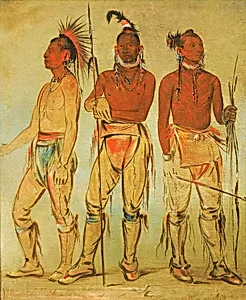
Mun-ne-pús-kee, He Who Is Not Afraid; Ko-ha-túnk-a, Big Crow; and Nah-cóm-ee-shee, Man of the Bed, Three Young Warriors
1834
Medium
Painting
Classification
Painting
Department
Smithsonian Collection
Museum
Smithsonian American Art Museum
Credit
Smithsonian American Art Museum, Gift of Mrs. Joseph Harrison, Jr.
Accession Number
1985.66.34-36
Rights
Public Domain
Tags
About this artwork
“These portraits set forth fairly the modes of dress and ornaments of the young men of the tribe, from the tops of their heads to the soles of their feet. The only dress they wear in warm weather is the breech-cloth, leggings, and moccasins of dressed skins, and garters worn immediately below the knee, ornamented profusely with beads and wampum. These three distinguished and ambitious young men were of the best families in the Osage Nation; and as they explained to me, having formed a peculiar a...
Art Historical Context
In 1834, American artist George Catlin captured a striking group portrait of three young Osage warriors at Fort Gibson in present-day Oklahoma: *Mun-ne-pús-kee (He Who Is Not Afraid, *Ko-ha-túnk-a (Big Crow)*, and *Nah-cóm-ee-shee (Man of the Bed, Three Young Warriors)*. Catlin, renowned for his depictions of Native American life during the early 19th century, painted them together at their own request, highlighting their close bond and status as members of the tribe's elite families. The painting meticulously documents traditional Osage attire for warm weather: breech-cloths, leggings, and moccasins of dressed skins, accented by beaded garters and wampum below the knee. As Catlin noted, it portrays "the modes of dress and ornaments... from the tops of their heads to the soles of their feet." This work exemplifies Catlin's mission to preserve vanishing Indigenous cultures amid U.S. expansion and Indian removal policies. Housed in the Smithsonian American Art Museum, this oil portrait holds cultural significance as a rare collaborative portrait requested by the subjects themselves, offering insight into Osage identity, ambition, and adornment during a transformative era.
About the Artist
George Catlin · 1796–1872
George Catlin (1796–1872), born in Wilkes-Barre, Pennsylvania, to Putnam Catlin and Polly Sutton—who had been captured by Native Americans during the 1778 Battle of Wyoming—initially pursued a legal career. Trained at Litchfield Law School, he was admitted to the bar in 1819 but abandoned law after two years to study art in Philadelphia in 1823. Self-taught as a portraitist, Catlin quickly gained ...