
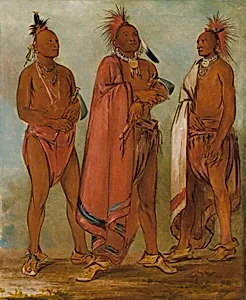
Wa-másh-ee-sheek, He Who Takes Away; Wa-chésh-uk, War; Mink-chésk, Three Distinguished Young Men
1834
Medium
Painting
Classification
Painting
Department
Smithsonian Collection
Museum
Smithsonian American Art Museum
Credit
Smithsonian American Art Museum, Gift of Mrs. Joseph Harrison, Jr.
Accession Number
1985.66.38-40
Rights
Public Domain
Tags
About this artwork
George Catlin described these members of the Osage tribe as “uniformly dressed in skins of their own dressing---strictly maintaining their primitive looks and manners, without the slightest appearance of innovations, excepting in the blankets, which have been recently admitted to their use instead of the buffalo robes . . .” Catlin painted this group portrait at Fort Gibson (in present-day Oklahoma) in 1834. (Catlin, Letters and Notes, vol. 2, no. 38, 1841; reprint 1973)
Art Historical Context
In 1834, artist George Catlin captured striking group portrait of three distinguished Osage men—Wa-másh-ee-sheek ("He Who Takes Away"),-chésh-uk (""), and Mink-ché—at Fort Gibson in present-day Oklahoma. Titled *Wa-másh-ee-sheek, He Who Takes; Wa-chésh-uk, War; Mink-chésk, Three Young Men*, the full-length painting showcases them in traditional attire: skins they dressed themselves, accented by recently adopted blankets replacing buffalo robes. An axe in hand hints at their warrior status, preserving their "primitive looks and manners" amid encroaching change. Catlin, a pioneering 19th-century painter dedicated to documenting Native American life before European influence erased it, created this work during his extensive travels West. His realistic style and ethnographic focus make the canvas a vivid historical record, emphasizing authenticity over idealization. Painted on canvas, it reflects his commitment to oil portraits that brought Indigenous dignity to Eastern audiences. Today, housed in the Smithsonian American Art Museum, this piece highlights the Osage Nation's cultural resilience during a turbulent era of removal and treaties. It invites visitors to appreciate not just artistic skill, but a poignant snapshot of sovereignty and tradition on the frontier.
About the Artist
George Catlin · 1796–1872
George Catlin (1796–1872), born in Wilkes-Barre, Pennsylvania, to Putnam Catlin and Polly Sutton—who had been captured by Native Americans during the 1778 Battle of Wyoming—initially pursued a legal career. Trained at Litchfield Law School, he was admitted to the bar in 1819 but abandoned law after two years to study art in Philadelphia in 1823. Self-taught as a portraitist, Catlin quickly gained ...