
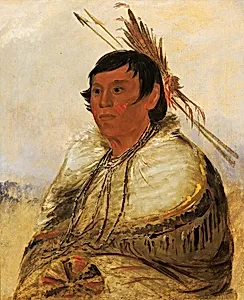
Ni-a-có-mo, Fix With the Foot, a Brave
1830
Medium
Painting
Classification
Painting
Department
Smithsonian Collection
Museum
Smithsonian American Art Museum
Credit
Smithsonian American Art Museum, Gift of Mrs. Joseph Harrison, Jr.
Accession Number
1985.66.254
Rights
Public Domain
Tags
About this artwork
“PI-AN-KE-SHAWS. The remnant of another tribe, of the states of Illinois and Indiana, who have also recently sold out their country to Government, and are under contract to move to the West of the Missouri, in the vicinity of Fort Leavenworth . . . [a] reduced and enfeebled tribe, which do not number more than 170 persons at this time.” George Catlin probably painted Fix with the Foot at Fort Leavenworth (in today’s Kansas) in 1830. (Catlin, Letters and Notes, vol. 2, no. 47, 1841; reprint 1973)
Art Historical Context
In 1830, American artist George Catlin captured the dignified likeness of Ni-a-có-mo, known as "Fix With the Foot, a Brave," in this striking portrait from the Smithsonian American Art Museum. Catlin, a pioneering chronicler of Native American life, painted during his travels among tribes facing upheaval, using oil on canvas to create realistic, empathetic depictions that preserved vanishing cultures. His style emphasized individual character and traditional attire, making this work a poignant example of early 19th-century ethnographic portraiture. The painting was likely created at Fort Leavenworth in present-day Kansas, a frontier outpost central to U.S. government relocation efforts. Ni-a-có-mo belonged to the Piankashaw people—a small remnant of a once-thriving Illinois and Indiana tribe, numbering just 170 souls by 1830. Having sold their ancestral lands, they were en route west of the Missouri River under contracts amid the Indian Removal policies that reshaped the American Midwest. Catlin's portrait holds enduring historical significance, offering a window into the resilience of Piankashaw identity amid displacement. As part of his ambitious "Indian Gallery," it underscores the artist's urgent mission to document Indigenous peoples before assimilation and loss, inviting viewers to reflect on a pivotal era of cultural transformation.
About the Artist
George Catlin · 1796–1872
George Catlin (1796–1872), born in Wilkes-Barre, Pennsylvania, to Putnam Catlin and Polly Sutton—who had been captured by Native Americans during the 1778 Battle of Wyoming—initially pursued a legal career. Trained at Litchfield Law School, he was admitted to the bar in 1819 but abandoned law after two years to study art in Philadelphia in 1823. Self-taught as a portraitist, Catlin quickly gained ...