
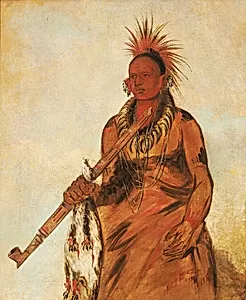
No-o-mún-nee, Walks in the Rain, a Warrior
1832
Medium
Painting
Classification
Painting
Department
Smithsonian Collection
Museum
Smithsonian American Art Museum
Credit
Smithsonian American Art Museum, Gift of Mrs. Joseph Harrison, Jr.
Accession Number
1985.66.258
Rights
Public Domain
Tags
About this artwork
George Catlin described Walks in the Rain as a “warrior, with his pipe and tobacco-pouch in his hand.” The subject may be the same as Walking Rain (see 1985.66.518). Catlin probably painted this work at Fort Leavenworth (in today’s Kansas) in 1832. (Truettner, The Natural Man Observed, 1979)
Art Historical Context
George Catlin's *No-o-mú-n-nee, Walks in the, a Warrior* (1832) captures the dignified likeness of an Iowa tribesman, possibly the same individual portrayed as Walking Rain in another work. As a pioneering 19th-century artist,lin meticulously documented Native American life through portraits like this one, often painting directly from life during his travels. Here, the warrior holds his pipe and tobacco pouch, symbols of status and ritual significance in Iowa culture, rendered with Catlin's characteristic attention to facial expression and adornment. Painted at Fort Leavenworth in present-day Kansas in 1832, this oil portrait reflects a pivotal moment in American history. Catlin created it amid the U.S. Army's "Dragoon Campaigns," which brought him into close contact with Plains tribes like the Iowa, whom he sought to preserve on canvas before Euro-American expansion altered their world forever. His works form a vital visual record of indigenous peoples on the cusp of profound change. This Smithsonian treasure highlights Catlin's role in early ethnographic art, blending portraiture with cultural advocacy. Visitors today can appreciate how it humanizes a warrior's pride, offering a window into Iowa traditions and the artist's urgent mission to celebrate the "natural man."
About the Artist
George Catlin · 1796–1872
George Catlin (1796–1872), born in Wilkes-Barre, Pennsylvania, to Putnam Catlin and Polly Sutton—who had been captured by Native Americans during the 1778 Battle of Wyoming—initially pursued a legal career. Trained at Litchfield Law School, he was admitted to the bar in 1819 but abandoned law after two years to study art in Philadelphia in 1823. Self-taught as a portraitist, Catlin quickly gained ...