
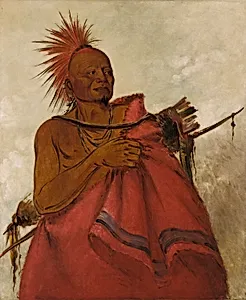
Tcha-tó-ga, Mad Buffalo, Murderer of Two White Men
1834
Medium
Painting
Classification
Painting
Department
Smithsonian Collection
Museum
Smithsonian American Art Museum
Credit
Smithsonian American Art Museum, Gift of Mrs. Joseph Harrison, Jr.
Accession Number
1985.66.41
Rights
Public Domain
Tags
About this artwork
According to George Catlin, Mad Buffalo, a member of the Osage tribe, “was tried and convicted for the murder of two white men during Adams's administration, and was afterwards pardoned, and still lives, though in disgrace in his tribe, as one whose life has been forfeited.” Catlin painted this portrait at Fort Gibson (in present-day Oklahoma) in 1834. (Catlin, Letters and Notes, vol. 2, no. 38, 1841; reprint 1973)
Art Historical Context
**Tcha-tó, Mad Buffalo, Murderer Two White Men** (1834) is a compelling portrait by George Catlin, the pioneering 19th-century American artist for his realistic depictions of Native American peoples.lin painted this waist-length portrait of Tcha-tó-ga, a member of the Osage, while at Fort Gibson in present-day Oklahoma—a key U.S. military outpost during turbulent era of Indian Territory relocation. Catlin's own notes reveal the subject's dramatic story: Mad Buffalo was tried and convicted for murdering two white men during President John Quincy Adams's administration (1825–1829), yet was later pardoned. Though spared, he lived in disgrace among his people, his life deemed forfeited by tribal standards. This painting captures a moment of profound cultural tension amid the 1830s Indian Removal policies, which displaced tribes like the Osage westward. As part of Catlin's vast ethnographic project—over 600 portraits documenting vanishing indigenous cultures before white expansion—this oil painting exemplifies his precise, empathetic realism. It invites us to reflect on justice, mercy, and the clash of worlds, preserved today in the Smithsonian American Art Museum through the gift of Mrs. Joseph Harrison, Jr.
About the Artist
George Catlin · 1796–1872
George Catlin (1796–1872), born in Wilkes-Barre, Pennsylvania, to Putnam Catlin and Polly Sutton—who had been captured by Native Americans during the 1778 Battle of Wyoming—initially pursued a legal career. Trained at Litchfield Law School, he was admitted to the bar in 1819 but abandoned law after two years to study art in Philadelphia in 1823. Self-taught as a portraitist, Catlin quickly gained ...