
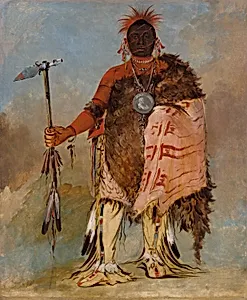
Om-pah-tón-ga, Big Elk, a Famous Warrior
1832
Medium
Painting
Classification
Painting
Department
Smithsonian Collection
Museum
Smithsonian American Art Museum
Credit
Smithsonian American Art Museum, Gift of Mrs. Joseph Harrison, Jr.
Accession Number
1985.66.114
Rights
Public Domain
Tags
About this artwork
A warrior of the Omaha tribe, Big Elk sat for his portrait, according to George Catlin, “with his tomahawk in his hand, and face painted black, for war.” Catlin probably painted this image at Fort Leavenworth (in today’s Kansas) in 1832. Big Elk also sat for artist Charles Bird King (1785-1862) some years earlier in Washington. (Catlin, Letters and Notes, vol. 2, no. 34, 1841; reprint 1973)
Art Historical Context
George Catlin's *Om-pah-tón-ga, Big Elk, a Famous Warrior* (1832) captures the commanding presence of a prominent Omaha tribe leader at Fort Leavenworth in present-day Kansas. Painted during Catlin's ambitious expedition to document Native American life and culture, the full-length portrait shows Big Elk gripping his tomahawk, his face boldly painted black in preparation for war, adorned in traditional Indian dress and jewelry. This striking image reflects Catlin's commitment to portraying Indigenous peoples with dignity and authenticity, preserving their likenesses amid rapid cultural changes. As part of Catlin's renowned Indian Gallery series, the oil painting exemplifies his realistic style, influenced by his training as a portraitist. Big Elk had previously sat for artist Charles Bird King in Washington, D.C., highlighting the growing fascination with Native leaders in early 19th-century America. Catlin's work, now in the Smithsonian American Art Museum, offers a vivid window into Omaha warrior traditions and the tense frontier dynamics of the 1830s, when U.S. expansion increasingly encroached on tribal lands. (178 words)
About the Artist
George Catlin · 1796–1872
George Catlin (1796–1872), born in Wilkes-Barre, Pennsylvania, to Putnam Catlin and Polly Sutton—who had been captured by Native Americans during the 1778 Battle of Wyoming—initially pursued a legal career. Trained at Litchfield Law School, he was admitted to the bar in 1819 but abandoned law after two years to study art in Philadelphia in 1823. Self-taught as a portraitist, Catlin quickly gained ...