
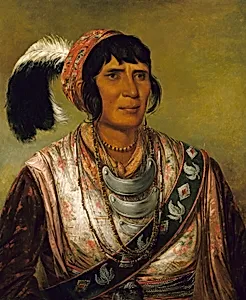
Os-ce-o-lá, The Black Drink, a Warrior of Great Distinction
1838
Medium
Painting
Classification
Painting
Department
Smithsonian Collection
Museum
Smithsonian American Art Museum
Credit
Smithsonian American Art Museum, Gift of Mrs. Joseph Harrison, Jr.
Accession Number
1985.66.301
Rights
Public Domain
Tags
About this artwork
George Catlin painted Seminole warrior Osceola at Fort Moultrie, near Charleston, South Carolina, in January 1838. The warrior, Catlin wrote, was “commonly called Powell . . .[he] is generally supposed to be a half-breed, the son [grandson] of a white man . . . and a Creek woman . . . I have painted him precisely in the costume, in which he stood for his picture, even to a string and a trinket. He wore three ostrich feathers in his head, and a turban made of a vari-coloured cotton shawl---and hi...
Art Historical Context
In 1838, George Catlin, a pioneering American artist dedicated to documenting Native American life, painted this striking portrait of Osceola (also known as Powell), a renowned Seminole warrior, at Fort Moultrie near Charleston, South Carolina. Catlin captured Osceola precisely as he appeared, adorned in a turban of colorful cotton shawl topped with three ostrich feathers, calico clothing, a beaded sash, and holding his rifle—a vivid snapshot of Seminole attire blending indigenous and traded elements. Osceola, possibly of mixed Creek and white heritage, emerged as a masterful leader during the Second Seminole War (1835–1842), rallying his people against forced removal from Florida despite not holding formal chief status. Catlin described him as of medium stature with graceful movements, a handsome face marked by a peculiar, effeminate smile, and gentlemanly manners, though he spoke only his native tongue—embodying the "full-blooded and wild Indian" spirit. This oil painting, now in the Smithsonian American Art Museum, exemplifies Catlin's ethnographic realism, part of his ambitious effort to preserve vanishing Indigenous cultures through hundreds of portraits. It offers a poignant window into Seminole resistance and resilience amid U.S. expansion.
About the Artist
George Catlin · 1796–1872
George Catlin (1796–1872), born in Wilkes-Barre, Pennsylvania, to Putnam Catlin and Polly Sutton—who had been captured by Native Americans during the 1778 Battle of Wyoming—initially pursued a legal career. Trained at Litchfield Law School, he was admitted to the bar in 1819 but abandoned law after two years to study art in Philadelphia in 1823. Self-taught as a portraitist, Catlin quickly gained ...