
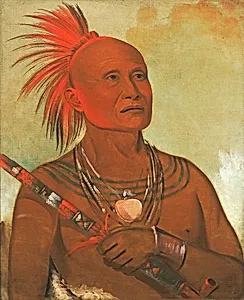
Pam-a-hó, The Swimmer, One of Black Hawk's Warriors
1832
Medium
Painting
Classification
Painting
Department
Smithsonian Collection
Museum
Smithsonian American Art Museum
Credit
Smithsonian American Art Museum, Gift of Mrs. Joseph Harrison, Jr.
Accession Number
1985.66.13
Rights
Public Domain
Tags
About this artwork
George Catlin painted Black Hawk and his warriors when they were prisoners at Jefferson Barracks near St. Louis in October 1832. Catlin's visit to Jefferson Barracks must have taken place shortly after he returned from the Upper Missouri. With the experience of his most productive summer behind him, he turned to the Sac prisoners, painting them with a sure economy that emphasizes the oval geometry of their features and their shaven skulls. (Truettner, The Natural Man Observed, 1979)
Art Historical Context
In 1832, amid the aftermath of the Black Hawk War artist George Catlin painted *Pam-a-hó, The Swimmer, One of Black Hawk's* while the Sauk leader and his captives were imprisoned Jefferson Barracks near St Louis. This portrait captures pivotal moment: Black Hawk, a prominent Sauk chief, had led a resistance against U.S. territorial expansion in and Wisconsin, but his defeat marked a tragic chapter in Native American displacement. Catlin, driven by a mission to document indigenous cultures before they vanished, seized the opportunity to portray these warriors shortly after his own expedition up the Upper Missouri River. Catlin's oil painting exemplifies his documentary style, blending Romantic idealism with precise observation. He employs a "sure economy" of brushwork, as noted by art historian William Truettner, to emphasize the oval geometry of Pam-a-hó's features and his shaven skull—a distinctive warrior trait. This geometric focus lends the portrait a striking, almost sculptural quality, humanizing the subject amid his captivity. Housed in the Smithsonian American Art Museum, this work stands as a vital historical record of Sauk and Fox peoples, offering visitors a window into 19th-century tensions between Native sovereignty and American manifest destiny. It's a poignant reminder of Catlin's urgent artistic legacy.
About the Artist
George Catlin · 1796–1872
George Catlin (1796–1872), born in Wilkes-Barre, Pennsylvania, to Putnam Catlin and Polly Sutton—who had been captured by Native Americans during the 1778 Battle of Wyoming—initially pursued a legal career. Trained at Litchfield Law School, he was admitted to the bar in 1819 but abandoned law after two years to study art in Philadelphia in 1823. Self-taught as a portraitist, Catlin quickly gained ...