
Peacocks and Peonies II
1882
Medium
Decorative Arts-Glass
Classification
Decorative Arts-Glass
Department
Smithsonian Collection
Museum
Smithsonian American Art Museum
Credit
Smithsonian American Art Museum, Gift of Henry A. La Farge
Accession Number
1936.12.2
Rights
Public Domain
Tags
About this artwork
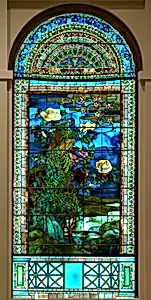
La Farge's stained-glass windows reflect the Gilded Age fascination with medieval art and craftsmanship. The industrial revolution had made inexpensive, mass-produced glass available to anyone, but art glass remained an emblem of wealth and good taste. These windows were commissioned by Frederick Lothrop Ames, a railroad magnate who had them installed in the vast, baronial hall of his Boston house. The tail feathers of the peacocks are made of bits of glass in the "broken jewel" technique; each ...
Art Historical Context
Step into the luminous world of John La Farge's *Peacocks and Pe II* (1882), a stunning stained-glass window from the Smithsonian American Art. Created during the Gilded Age this piece captures the era's obsession with medieval craftsmanship amid the Industrial Revolution's flood of mass-produced glass.ed by railroad magnate Lothrop Ames for his Boston mansion, it symbolized wealth and refined taste, transforming everyday light into a spectacle of color and elegance. La Farge, a pioneer in American opalescent glass, employed innovative techniques like the "broken jewel" method—tiny glass fragments forming the peacocks' iridescent tail feathers—and single, molded peony blossoms that shift hues with the day's light. He layered colors much like a painter builds glazes, achieving painterly depth in a medium traditionally flat and static. Drawing from global inspirations, the central bird-and-flower motifs echo Chinese and Japanese screens, while lower panels mimic Pompeian architecture and transoms recall Romanesque cathedral tympana. This fusion highlights La Farge's role in reviving stained glass as high art, blending Eastern exoticism with Western grandeur for an enduring Gilded Age treasure. (198 words)
About the Artist
John La Farge · 1835–1910
John La Farge (1835–1910) was born into a wealthy French émigré family in New York City, the son of John Frederick La Farge and Louisa Binsse de Saint-Victor. Educated at Jesuit institutions including Mount St. Mary's College in Maryland and St. John's College (now Fordham University), he initially pursued law but turned to art after receiving early drawing lessons from his maternal grandfather, a...