
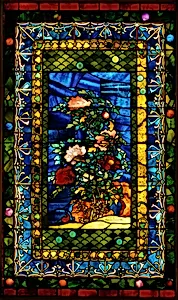
Peonies Blown in the Wind
ca. 1880
Medium
Leaded opalescent glass
Dimensions
75 x 45 in. (190.5 x 114.3 cm)
Classification
Stained glass window
Culture
American
Department
The American Wing
Museum
Metropolitan Museum of Art, New York, NY
Credit
Gift of Susan Dwight Bliss, 1930
Accession Number
30.50
Rights
Public Domain
Tags
Art Historical Context
John La Farge'sPeonies Blown in Wind* (ca. 1880) is a stunning example of American innovation in stained glass, now housed in The Metropolitan Museum of Art's American Wing. This large-scale window panel, measuring 75 x 45 inches, captures the delicate drama of peonies swaying in a breeze, their petals unfurling in vibrant pinks, whites, and greens. Gifted by Susan Dwight Bliss in 193, it exemplifies the Aesthetic Movement's embrace of beauty for its own sake during America's Gilded Age. La Farge, a pioneering artist (1835–1910), transformed stained glass with his invention of opalescent glass—a technique layering iridescent slabs to mimic natural light's shimmer, eliminating the need for traditional painting. Leaded opalescent glass here creates a luminous, jewel-like glow, evoking Japanese ukiyo-e prints that influenced him. The dynamic composition, with flowers bent by an invisible wind, blends realism and impressionistic movement, showcasing his mastery of light as a sculptural force. As a window, it was designed to interact with daylight, bathing interiors in ethereal color—perfect for Victorian homes or churches. This piece highlights La Farge's role in elevating American decorative arts to fine art status, bridging East and West in a fleeting, wind-swept moment of natural beauty.
About the Artist
John La Farge · 1835–1910
John La Farge (1835–1910) was born into a wealthy French émigré family in New York City, the son of John Frederick La Farge and Louisa Binsse de Saint-Victor. Educated at Jesuit institutions including Mount St. Mary's College in Maryland and St. John's College (now Fordham University), he initially pursued law but turned to art after receiving early drawing lessons from his maternal grandfather, a...