
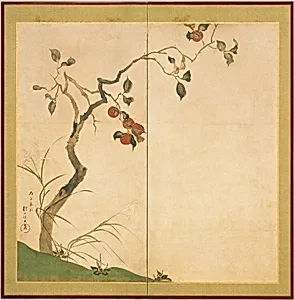
酒井抱一筆 柿図屏風|Persimmon Tree
1816
Medium
Two-panel folding screen; ink and color on paper
Dimensions
Image: 56 9/16 × 56 5/8 in. (143.7 × 143.8 cm) Overall: 64 1/8 in. × 64 in. (162.9 × 162.6 cm)
Classification
Paintings
Culture & Period
Japan · Edo period (1615–1868)
Department
Asian Art
Museum
Metropolitan Museum of Art, New York, NY
Credit
Rogers Fund, 1957
Accession Number
57.156.3
Rights
Public Domain
Tags
Art Historical Context
Step into the serene world of Edo-period Japan with Sakai Hōitsu *Persimmon Tree* (1816), a masterful two-panel folding screen from the Metropolitan Museum of Art. Created during the vibrant Edo era (1615–1868), when artistic refinement flourished amid urban prosperity, this work exemplifies Hōitsu's role in reviving the Rinpa school decorative style blending bold compositions, nature motifs, and elegant asymmetry. Hōitsu, a poet-turned-painter, drew inspiration from earlier Rinpa masters like Ogata Kōrin, infusing screens like this with poetic simplicity. Rendered in ink and color on paper, the screen captures a laden persimmon tree in luminous detail, its ripe orange fruits glowing against delicate branches. Measuring nearly five feet square, these byōbu (folding screens) were prized room dividers in affluent Japanese homes, transforming interiors into immersive gardens. Hōitsu's technique employs rhythmic lines and subtle gradations, evoking autumn's bounty—persimmons symbolizing perseverance and good fortune in Japanese culture. Displayed in the Asian Art department (Rogers Fund, 1957), this piece invites reflection on nature's ephemerality, a Rinpa hallmark that influenced centuries of decorative arts. A timeless treasure! (198 words)
About the Artist
Sakai Hōitsu · 1761–1828
Japanese, 1761–1828