
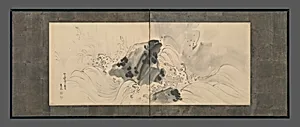
Rock and Waves
dated 1773
Medium
Two-panel folding screen; ink and color on paper
Dimensions
Image: 22 in. × 53 3/8 in. (55.9 × 135.6 cm) Overall: 29 1/4 in. × 74 in. (74.3 × 188 cm)
Classification
Paintings
Culture & Period
Japan · Edo period (1615–1868)
Department
Asian Art
Museum
Metropolitan Museum of Art, New York, NY
Credit
Seymour Fund, 1957
Accession Number
57.156.1
Rights
Public Domain
Tags
Art Historical Context
Maruyama Ōkyo's *Rock and Waves* (1773) is a captivating two-panel folding screen, rendered in ink and color on paper, measuring nearly six feet across. This intimate yet dynamic work captures the raw power of nature—a rugged rock formation battered by surging waves—evoking the timeless drama of Japan's coastal landscapes. Housed in the Metropolitan Museum of Art's Art collection, it exemplifies Edo-period (1615–1868) painting, a time of peace and prosperity when screens like this adorned elite homes and tea houses as portable art. Ōkyo, a pioneering artist who founded the Maruyama-Shijō school, revolutionized Japanese painting by blending meticulous realism with traditional ink techniques. Influenced by close observation of nature, he achieved lifelike textures: the spray of foam, the glistening wetness of rocks, and the fluid motion of water. This marked a shift from stylized literati painting toward accessible, naturalistic styles that appealed to a broader audience beyond court elites. Folding screens were prized for their versatility, unfolding to transform spaces and immerse viewers in seasonal or elemental scenes. *Rock and Waves* highlights the Japanese reverence for nature's forces—waves symbolizing impermanence in Zen thought—inviting contemplation amid the Edo era's urban bustle. A Seymour Fund acquisition in 1957, it remains a testament to Ōkyo's enduring legacy.