
Pilgrim Bottle Fragment
Unknown Artist
9th century (?)
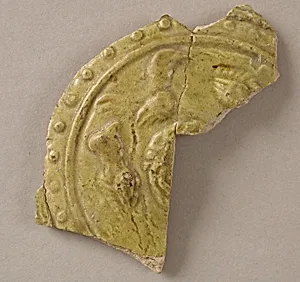
Medium
Earthenware, glaze
Dimensions
Overall: 2 1/2 x 2 15/16 x 3/16 in. (6.4 x 7.4 x 0.5 cm)
Classification
Ceramics
Culture
Visigothic (?)
Department
Medieval Art
Museum
Metropolitan Museum of Art, New York, NY
Credit
Gift of J. Pierpont Morgan, 1917
Accession Number
17.194.1712
Rights
Public Domain
Art Historical Context
This delicate fragment from a pilgrim bottle offers a glimpse into early medieval in the Iberian Peninsula. Dating to the 9th century (?), hails from Visigothic culture (?), period when the Visig ruled much of Spain and Portugal before the Islamic conquest Pilgrim bottles like this were vessels carried by travelers and pilgrims, to hold holy water or during journeys to sacred sites. Though only a small shard survivesmeasuring just 2 1/2 x 2 15/16 x /16 inches—it evokes the mobility and devotion of the era. Crafted from earthenware with a glaze, this piece highlights an important advancement in ceramic technology. The glaze not only sealed the porous clay for better liquid containment but also added a glossy sheen, enhancing both utility and aesthetic appeal. Such techniques were rare in early medieval Europe, pointing to skilled local potters blending functionality with subtle artistry in the Medieval Art tradition. Generously gifted to the Metropolitan Museum of Art by J. Pierpont Morgan in 1917, this fragment invites us to ponder the everyday objects that shaped spiritual and cultural exchanges centuries ago. A testament to resilience, it survives as a quiet survivor of history's upheavals.