
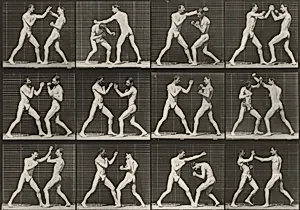
Plate Number 336. Boxing, open hand
Medium
collotype
Dimensions
image: 22.75 × 32.3 cm (8 15/16 × 12 11/16 in.) sheet: 48.4 × 61.3 cm (19 1/16 × 24 1/8 in.)
Classification
Photograph
Department
CPH
Museum
National Gallery of Art, Washington, D.C.
Credit
Corcoran Collection (Museum Purchase, 1887)
Accession Number
2014.79.361
Rights
Public Domain
Art Historical Context
Step into the groundbreaking world of motion captured in stillness with *Plate Number 336. Boxing, open* by Eadweard Muybridge, created in 1887. This collotype print is part of Muybridge's monumental *Animal Locomotion* series, a 781-plate study that revolutionized how we understand movement. Using a battery of 12 to 24 cameras triggered in rapid succession, Muybridge froze the human body in sequential action—here, a male figure mid-boxing pose with an open hand, showcasing the fluid dynamics of sport and exertion. Collotype, a photomechanical printing technique, allowed for exquisite detail in reproducing these high-speed photographs, making Muybridge's innovations accessible beyond the lab. His work, commissioned by institutions like the University of Pennsylvania, debunked artistic myths about anatomy in motion (like galloping horses) and paved the way for cinema, influencing filmmakers from Edison to the Lumière brothers. Housed in the National Gallery of Art's Corcoran Collection, this 22.75 × 32.3 cm image invites us to marvel at 19th-century ingenuity—a bridge between photography's static origins and the moving pictures that define modern entertainment. Imagine the athlete's poise frozen forever, a testament to human curiosity and athletic grace.
About the Artist
Eadweard Muybridge · 1830–1904
Eadweard Muybridge (1830-1904) was an English-American photographer who revolutionized the understanding of motion through his pioneering chronophotographic studies. Born Edward James Muggeridge in Kingston upon Thames, England, he emigrated to America and became famous first for his dramatic landscape photographs of Yosemite Valley, then for his groundbreaking motion studies that proved horses li...