
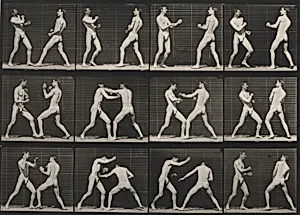
Plate Number 338. Boxing, open hand
Medium
collotype
Dimensions
image: 22.9 × 32.4 cm (9 × 12 3/4 in.) sheet: 48.4 × 61.4 cm (19 1/16 × 24 3/16 in.)
Classification
Photograph
Department
CPH
Museum
National Gallery of Art, Washington, D.C.
Credit
Corcoran Collection (Museum Purchase, 1887)
Accession Number
2014.79.363
Rights
Public Domain
Art Historical Context
Eadweard Muybridge *Plate Number 338., open hand* (1887) captures a pivotal moment in the history of photography and motion studies. Part of Muybridge's groundbreaking *Animal Locomotion*, this collotype print freezes a nude male figure mid-boxing stance, palm extended, showcasing the artist's obsession with dissecting human movement. Commissioned initially for scientific study, these sequential images revolutionized how we understand anatomy in action, bridging art, science, and early cinema. Printed via collotype—a precise photomechanical process that allowed for richly detailed reproductions—this 22.9 × 32.4 cm image on a larger 48.4 × 61.4 cm sheet exemplifies Muybridge's technical innovation. Using banks of cameras triggered by electro-mechanical devices, he produced thousands of plates like this one, proving that even the galloping horse (famously) had all four hooves off the ground at times. Acquired by the Corcoran Gallery in 1887 and now in the National Gallery of Art's Corcoran Collection, it highlights photography's shift from static portraiture to dynamic analysis. This work not only influenced artists like Marcel Duchamp and filmmakers like the Lumière brothers but also sparked debates on nudity in art versus science. Visitors, imagine the thrill of Muybridge's Victorian-era "zoöpraxiscope" projecting these plates to life—early motion pictures in the making!
About the Artist
Eadweard Muybridge · 1830–1904
Eadweard Muybridge (1830-1904) was an English-American photographer who revolutionized the understanding of motion through his pioneering chronophotographic studies. Born Edward James Muggeridge in Kingston upon Thames, England, he emigrated to America and became famous first for his dramatic landscape photographs of Yosemite Valley, then for his groundbreaking motion studies that proved horses li...