
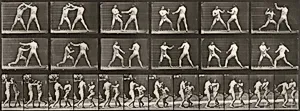
Plate Number 329. Boxing
Medium
collotype
Dimensions
image: 17 × 45.5 cm (6 11/16 × 17 15/16 in.) sheet: 48.4 × 61.3 cm (19 1/16 × 24 1/8 in.)
Classification
Photograph
Department
CPH
Museum
National Gallery of Art, Washington, D.C.
Credit
Corcoran Collection (Museum Purchase, 1887)
Accession Number
2014.79.354
Rights
Public Domain
Art Historical Context
Step into the groundbreaking world of motion photography with *Plate Number 329. Boxing* by Eadweard Muybridge, created in 1887. This collotype print, part of his monumental *Animal Locomotion* series, captures a dynamic of two boxers in action across 17 × 45.5 cm of vivid imagery. Muybridge, a pioneering British-American photographer, used a battery of up to 24 cameras triggered sequentially by the subjects' movements, freezing split-second moments that the human eye could scarcely perceive. The collotype medium—a finely detailed printing process—allowed for precise reproduction of these high-speed exposures, making Muybridge's work accessible beyond the lab. Produced amid his Stanford-commissioned studies that debunked myths about animal gait (famously proving a horse's airborne gallop), this plate exemplifies his scientific rigor fused with artistic vision. Boxing's rhythmic punches and dodges highlight human anatomy in fluid motion, bridging photography's static past with film's kinetic future. Today, housed in the National Gallery of Art's Corcoran Collection, this piece underscores Muybridge's influence on cinema pioneers like the Lumière brothers and modern stop-motion animation. It's a testament to how one man's curiosity transformed visual art, inviting us to marvel at the poetry of movement etched in time.
About the Artist
Eadweard Muybridge · 1830–1904
Eadweard Muybridge (1830-1904) was an English-American photographer who revolutionized the understanding of motion through his pioneering chronophotographic studies. Born Edward James Muggeridge in Kingston upon Thames, England, he emigrated to America and became famous first for his dramatic landscape photographs of Yosemite Valley, then for his groundbreaking motion studies that proved horses li...