
Rhea Silvia
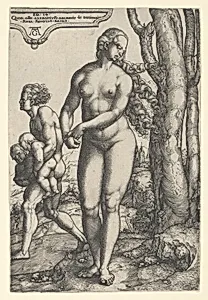
Medium
Engraving
Dimensions
Sheet: 5 13/16 × 3 15/16 in. (14.7 × 10 cm)
Classification
Prints
Department
Drawings and Prints
Museum
Metropolitan Museum of Art, New York, NY
Credit
Gift of Felix M. Warburg and his family, 1941
Accession Number
41.1.129
Rights
Public Domain
Tags
Art Historical Context
In the intricate engraving *Rhea Silvia* (1532), German artist Heinrich Aldegre captures a pivotal moment from Roman mythology. Rhea Silvia, a vestal virgin and mother of the twin founders of Rome, Romulus and Remus, is depicted in a nude, maternal pose with infants, evoking themes of divine intervention and fertility. Aldegrever, a figure among the "Little Masters" of the Northern Renaissance, specialized in small-scale prints that rivaled the finesse of larger paintings, blending classical antiquity with the era's meticulous detail and humanism. Created as an engraving on a modest sheet measuring just 5 13/16 × 3 15/16 inches, this work exemplifies the revolutionary medium of the 16th century. Engravings allowed artists like Aldegrever to produce affordable, reproducible images that popularized mythological narratives across Europe, bridging elite patronage and broader audiences. The fine lines and textures highlight his mastery of burin techniques, rendering soft flesh, flowing drapery, and tender expressions with remarkable precision. Today, this gem resides in the Metropolitan Museum of Art's Drawings and Prints department, a gift from Felix M. Warburg and his family in 1941. It invites visitors to ponder how Renaissance printmakers revived ancient myths, making epic tales intimately accessible.
About the Artist
Heinrich Aldegrever · 1502–1561
Heinrich Aldegrever, born in 1502 in Paderborn, Westphalia, to parents Herman and Katherine Trippenmeker—a family of clog-makers known by the dialect name Trippenmecker—emerged as a multifaceted artist in the German Renaissance. His early training remains undocumented, though he likely apprenticed in a Soest goldsmith's workshop after relocating there around 1525, where he joined the painters' gui...