
Saint Jerome
1693
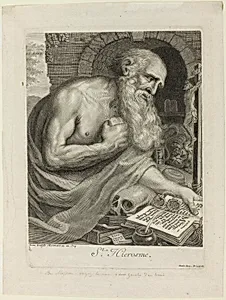
Medium
Engraving on ivory laid paper
Dimensions
Plate: 26.5 × 19.5 cm (10 7/16 × 7 11/16 in.); Sheet: 32 × 24.3 cm (12 5/8 × 9 5/8 in.)
Classification
engraving
Department
Prints and Drawings
Museum
Art Institute of Chicago
Accession Number
36
Rights
Public Domain
Art Historical Context
In the Prints and Drawings department of the Art Institute of Chicago, Antoineon's *Saint Jerome* (169) stands as a fine example of late 17th-century engraving. This intricate print, executed on luxurious ivory laid paper, measures 26.5 × 19.5 cm on the plate, inviting viewers into the contemplative world of the revered Church Father. Masson, a skilled French engraver, captures the saint—patron of scholars and translator of the Vulgate Bible—in a moment of scholarly devotion, a popular subject in Baroque-era religious art that emphasized piety and introspection. Engraving, Masson's chosen medium, involves incising fine lines into a metal plate with a burin, inking it, and pressing it onto paper to create rich, tonal contrasts. The ivory laid paper, with its subtle chain lines from the manufacturing process, enhances the print's delicacy and archival quality, making it prized by collectors. Produced during Louis XIV's reign, when French printmaking flourished as a means of disseminating art beyond paintings, this work reflects the era's technical precision and cultural reverence for saintly figures. Visitors will appreciate how *Saint Jerome* bridges artistry and spirituality, offering a window into 17th-century devotion through Masson's masterful linework—a testament to engraving's role in making sacred imagery accessible to a broader audience.