
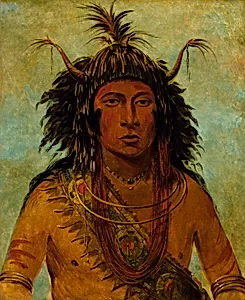
Say-say-gon, Hail Storm, War Chief
1845
Medium
Painting
Classification
Painting
Department
Smithsonian Collection
Museum
Smithsonian American Art Museum
Credit
Smithsonian American Art Museum, Gift of Mrs. Joseph Harrison, Jr.
Accession Number
1985.66.532
Rights
Public Domain
Tags
About this artwork
George Catlin described Hail Storm as “a fine and intelligent Indian,” thirty-one years old. Hail Storm was among the Canadian Ojibwe who joined Catlin in Paris in the late summer of 1845, having heard of the Iowa's successful engagement in Catlin’s traveling show. In early October the Ojibwe entertained Louis Philippe and the royal family at Saint-Cloud with ball games and dances, and the king reciprocated by asking Catlin to display the Indian Gallery in the Salle de Séance at the Louvre. Afte...
Art Historical Context
**Say-say-gon, Hail Storm, War Chief**1845) by Georgelin captures the dignified bust portrait of a 31-year-old Ojibwe war chief from Canada, whom Catlin described as “a fine and intelligent Indian Painted in oil, this work is part of Catlin’s vast Indian Gallery, a pioneering collection documenting Native American life and leaders before widespread cultural disruption. Catlin, a key figure in 19th-century American art traveled extensively among tribes in the 1830s, using realistic portraiture to preserve their likenesses amid rapid change, blending Romantic idealism with ethnographic detail. Created during a dramatic European tour, the portrait reflects Hail Storm’s journey with fellow Canadian Ojibwe who joined Catlin in Paris in late summer 1845, inspired by the success of his Iowa delegation. They performed ball games and dances for King Louis Philippe and the royal family at Saint-Cloud, prompting the king to host Catlin’s gallery at the Louvre—a rare honor. Tragedy struck in Belgium when smallpox claimed several lives, canceling the tour; Catlin parted from survivors in Antwerp in January 1846. This painting underscores Catlin’s dual role as artist and advocate, highlighting Ojibwe resilience and the fleeting intercultural exchanges of the era. Now in the Smithsonian American Art Museum, it invites reflection on Native voices in a global spotlight.
About the Artist
George Catlin · 1796–1872
George Catlin (1796–1872), born in Wilkes-Barre, Pennsylvania, to Putnam Catlin and Polly Sutton—who had been captured by Native Americans during the 1778 Battle of Wyoming—initially pursued a legal career. Trained at Litchfield Law School, he was admitted to the bar in 1819 but abandoned law after two years to study art in Philadelphia in 1823. Self-taught as a portraitist, Catlin quickly gained ...