
Sioux Dog Feast
1832-1837
Medium
Painting
Classification
Painting
Department
Smithsonian Collection
Museum
Smithsonian American Art Museum
Credit
Smithsonian American Art Museum, Gift of Mrs. Joseph Harrison, Jr.
Accession Number
1985.66.494
Rights
Public Domain
Tags
About this artwork
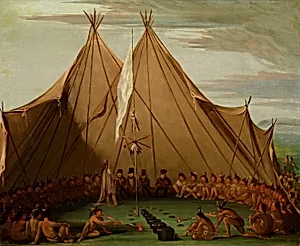
George Catlin participated in a Sioux Indian ceremony of friendship at which a meal of dog meat was the center of the event. He explained the significance of this meal in his journal: "This feast was unquestioningly given to us as the most undoubted evidence they could give of their friendship. Knowing the spirit in which it was given, we could not but treat it respectfully, and receive it as anything but a high and marked compliment. The dog feast is truly a religious ceremony. The Indian sees ...
Art Historical Context
George Catlin's *Sioux Dog Feast*1832–1837) captures a profound moment from the artist's extensive travels among Native American tribes in the American West. A pioneering painter and ethnographer, Catlin documented cultures through hundreds of portraits and scenes, often in oil on canvas, to preserve them amid rapid societal changes. This painting depicts a Dakota Sioux ceremony inside a teepee, where men partake in a ritual meal centered on dog meat—a practice Catlin witnessed firsthand during a friendship rite. In his journal, Catlin described the event's deep cultural weight: "This feast was unquestioningly given to us as the most undoubted evidence they could give of their friendship... The dog feast is truly a religious ceremony. The Indian sees fit to sacrifice his faithful companion to bear testimony to the sacredness of his vows of friendship." Far from mere sustenance, the dog symbolized unwavering loyalty, its offering a supreme gesture of honor and alliance. Housed in the Smithsonian American Art Museum, this work highlights Catlin's role in bridging worlds, offering modern viewers a window into Sioux traditions while sparking reflection on cross-cultural exchanges in 19th-century America.
About the Artist
George Catlin · 1796–1872
George Catlin (1796–1872), born in Wilkes-Barre, Pennsylvania, to Putnam Catlin and Polly Sutton—who had been captured by Native Americans during the 1778 Battle of Wyoming—initially pursued a legal career. Trained at Litchfield Law School, he was admitted to the bar in 1819 but abandoned law after two years to study art in Philadelphia in 1823. Self-taught as a portraitist, Catlin quickly gained ...