
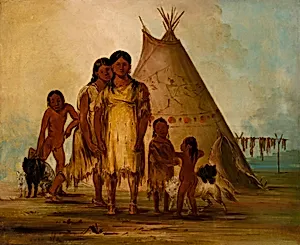
Two Comanche Girls
1834
Medium
Painting
Classification
Painting
Department
Smithsonian Collection
Museum
Smithsonian American Art Museum
Credit
Smithsonian American Art Museum, Gift of Mrs. Joseph Harrison, Jr.
Accession Number
1985.66.53-54
Rights
Public Domain
Tags
About this artwork
The scene, painted by George Catlin at a Comanche village in 1834, shows “the wigwam of the Chief, his dogs, and his five children.” The artist also described the village as “six or eight hundred skin-covered lodges, made of poles and buffalo skins, in the manner precisely as those of the Sioux and other Missouri tribes . . . This village with its thousands of wild inmates, with horses and dogs, and wild sports and domestic occupations, presents a most curious scene; and the manners and looks of...
Art Historical Context
George Catlin's *Two Comanche Girls*1834) captures a poignant moment from his travels among Native American tribes in the early 19th century. As a pioneering artist and ethnographer, Catlin journeyed westward to document the lives of Indigenous peoples before widespread European-American encroachment altered their worlds forever. Painted on-site at a Comanche village, oil painting reflects his commitment to authentic portraiture and scenes of daily life, aligning with the Romantic era's fascination with the "noble savage" and vanishing cultures. The artwork depicts two young Comanche girls amid the chief's wigwam—likely a skin-covered lodge of poles and buffalo hides, akin to those of the Sioux and other Plains tribes. Catlin vividly described the bustling village of 600 to 800 such lodges, teeming with "thousands of wild inmates," horses, dogs, and lively domestic scenes. Though the title spotlights the girls, the composition evokes the chief's family, including his five children and loyal dogs, offering a window into Comanche communal life rich with wild sports and traditions. Catlin's meticulous observations, later detailed in his *Letters and Notes* (1841), underscore the painting's historical value as one of the earliest visual records of the Comanche, fierce horse-mounted warriors of the Southern Plains. Housed in the Smithsonian American Art Museum, it invites visitors to reflect on the resilience and vibrancy of a people whose stories endure through such artistic legacies.
About the Artist
George Catlin · 1796–1872
George Catlin (1796–1872), born in Wilkes-Barre, Pennsylvania, to Putnam Catlin and Polly Sutton—who had been captured by Native Americans during the 1778 Battle of Wyoming—initially pursued a legal career. Trained at Litchfield Law School, he was admitted to the bar in 1819 but abandoned law after two years to study art in Philadelphia in 1823. Self-taught as a portraitist, Catlin quickly gained ...