
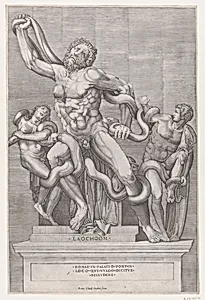
Speculum Romanae Magnificentiae: Laocoon
16th century
Medium
Engraving
Dimensions
sheet: 19 11/16 x 13 in. (50 x 33 cm)
Classification
Prints
Department
Drawings and Prints
Museum
Metropolitan Museum of Art, New York, NY
Credit
Harris Brisbane Dick Fund, 1941
Accession Number
41.72(2.78)
Rights
Public Domain
Tags
Art Historical Context
This striking 16th-century engraving captures the dramatic ancient sculpture of Laocoön and his sons struggling against serpents, a work rediscovered in Rome in 1506 that profoundly influenced Renaissance artists. Created as part of the *Speculum Romanae Magnificentiae* (Mirror of Roman Magnificence), the print belongs to a celebrated series that documented classical antiquities for a wide European audience. Through detailed linework typical of engraving, the image translates the sculpture’s twisting forms and intense emotion into a reproducible format, allowing viewers far from Italy to study one of antiquity’s most celebrated masterpieces. The engraving is attributed to Nicolas Beatrizet, a French printmaker active in Rome, and published by Claudio Duchetti, whose workshop specialized in disseminating images of Roman art. These reproductive prints played a vital role in the period’s renewed fascination with classical culture, serving both as artistic models and educational tools. By highlighting the male figures’ powerful anatomy and the serpents’ sinuous coils, the work invites contemplation of human vulnerability and heroic struggle—themes that resonated deeply in Renaissance thought. Measuring roughly 50 by 33 centimeters, this impression from the Metropolitan Museum of Art exemplifies how printmaking bridged the ancient and early modern worlds, preserving and popularizing Rome’s artistic legacy for generations of artists and scholars.
About the Artist
Claudio Duchetti|Nicolas Beatrizet ( |Italian) · |1565 – |1585
|Italian, active Venice and Rome, ca. 1565–died ca. 1585