
Speculum Romanae Magnificentiae: The Ocean God
Medium
Engraving; third state of three (Robert-Dumesnil)
Dimensions
sheet: 11 13/16 x 13 15/16 in. (30 x 35.4 cm)
Classification
Prints
Department
Drawings and Prints
Museum
Metropolitan Museum of Art, New York, NY
Credit
Harris Brisbane Dick Fund, 1941
Accession Number
41.72(2.96)
Rights
Public Domain
Tags
Art Historical Context
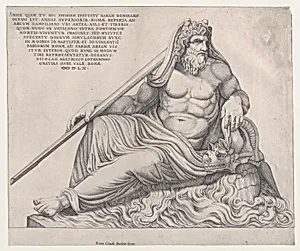
This engraving, titled *The Ocean God*, was created in 1560 by Nicolas Beatrizet and published by Claudio Duchetti as part of the *Speculum Romanae Magnificentiae* (Mirror of Roman Magnificence). This ambitious series compiled prints of ancient Roman sculptures, monuments, and architectural details, capturing the Renaissance fascination with classical antiquity. Rendered in engraving—a technique prized for its ability to convey fine detail and texture—the work depicts the majestic figure of Oceanus, the primordial sea deity, surrounded by marine motifs that evoke the power and mystery of the natural world. Beatrizet, a skilled French engraver active in Rome, drew upon antique sources to bring this mythological subject to life for a 16th-century audience. The print’s third state reflects careful revisions that refined its visual impact, ensuring the god’s flowing beard, muscular form, and symbolic attributes remained vivid. Such engravings played a vital role in disseminating knowledge of Rome’s artistic heritage across Europe, allowing scholars, artists, and collectors to study classical ideals without traveling to Italy. Today, this work highlights the enduring dialogue between ancient mythology and Renaissance innovation. Housed in the Metropolitan Museum of Art’s collection of drawings and prints, it invites viewers to appreciate how printmaking bridged past and present, preserving the grandeur of Roman art for generations.
About the Artist
Nicolas Beatrizet|Claudio Duchetti · 1515–1566
Nicolas Beatrizet, born around 1515 in Lunéville, Lorraine (then part of the Holy Roman Empire), emerged as one of the most prolific French engravers of the 16th century. Little is known about his early life and training, with no records of specific teachers or apprenticeships, though regional influences from German and Italian printmaking likely shaped his skills before he arrived in Rome around ...