
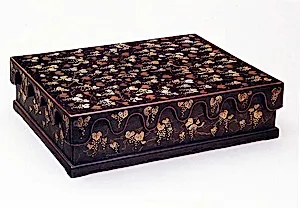
Stationery box with decoration of grapes and squirrels
Unknown Artist
17th century
Medium
Black lacquer with mother-of-pearl inlay and gold painting
Dimensions
H. 4 3/4 in. (12.1 cm); L. 17 3/4 in. (45.1 cm); W. 14 1/4 in. (36.2 cm)
Classification
Lacquer
Culture
Japan (Ryūkyū Islands)
Department
Asian Art
Museum
Metropolitan Museum of Art, New York, NY
Credit
Gift of Florence and Herbert Irving, 2019
Accession Number
2019.193.45a, b
Rights
Public Domain
Art Historical Context
This exquisite 17th-century stationery from the Ryūkyū Islands (modern-day Okinawa, Japan) showcases the pinnacle of East Asian lacquer artistry. Crafted in black lacquer with intricate mother-of-pearl inlay and gold painting, it measures a generous 17¾ by 14¼ inches, making it a substantial yet elegant container for writing implements and papers. The playful decoration of grapes and squirrels evokes abundance and whimsy—grapes symbolizing prosperity in Asian iconography, while squirrels add a lively, naturalistic touch. Ryūkyū lacquerware, produced during the kingdom's flourishing trade era as a tributary to China and Japan, was prized worldwide for its technical mastery. The black lacquer base, likely polished to a mirror-like roironuri finish, provides a dramatic canvas for the shimmering mother-of-pearl (raden) inlays and delicate gold accents, techniques that demanded immense skill and patience. Multiple layers of sap-derived urushi lacquer were applied, inlaid with iridescent shell slices, and gilded—a process taking months. Gifted to the Metropolitan Museum of Art in 2019, this anonymous masterpiece highlights the Ryūkyū Islands' role in exporting luxury goods during the Edo period, blending utility with opulence for scholars and elites. Visitors will appreciate its tactile allure, a testament to craftsmanship that transcends time.