
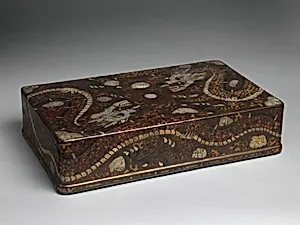
나전 대모 어피 용 무늬 옷상자 조선|螺鈿玳瑁魚皮龍文衣箱子 朝鮮|Clothing box decorated with dragons
Unknown Artist
19th century
Medium
Lacquer inlaid with mother-of-pearl, tortoiseshell, and ray skin
Dimensions
H. 6 3/4 in. (17.1 cm); W. 17 3/4 in. (45.1 cm); L. 28 3/4 in. (73 cm)
Classification
Lacquer
Culture & Period
Korea · Joseon dynasty (1392–1910)
Department
Asian Art
Museum
Metropolitan Museum of Art, New York, NY
Credit
Gift of Florence and Herbert Irving, 2015
Accession Number
2015.500.3.7a, b
Rights
Public Domain
Tags
Art Historical Context
This exquisite clothing box, known as *Na jeon dae mo eo pi yong muni ot sangja* in Korean, hails from the Joseon (1392–1910), specifically the 19th century. Crafted during a period when Korea's artisanal traditions flourished under Confucian ideals of refinement and harmony, this lacquerware piece served as a luxurious storage container for fine garments, reflecting the elite status of its owner. Measuring 28¾ inches long, it exemplifies the Joseon era's mastery of decorative arts, now housed in the Metropolitan Museum of Art's Asian Art department as a gift from Florence and Herbert Irving. The box's surface is a testament to intricate inlay techniques: lacquer forms the base, adorned with shimmering mother-of-pearl (najeon), tortoiseshell (dae mo), and ray skin (eo pi). Delicate dragon motifs—powerful symbols of imperial authority, protection, and good fortune in East Asian culture—grace its design, cut and fitted with precision to create a luminous, iridescent effect. These materials, sourced from nature, were labor-intensive to work with, highlighting the skill of anonymous Joseon craftsmen who elevated everyday objects into art. In Joseon society, such boxes were prized heirlooms, blending utility with opulence. Dragons evoked the king's auspicious energy, making this piece not just functional, but a cultural emblem of prosperity and harmony. Visitors can marvel at how these techniques preserved beauty across centuries.