
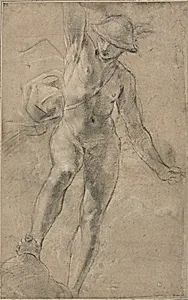
Study for Mercury
1613/14
Medium
Black chalk, heightened with white chalk, on tan laid paper, laid down on brownish-gray laid paper
Dimensions
42 × 26 cm (16 9/16 × 10 1/4 in.)
Classification
chalk
Department
Prints and Drawings
Museum
Art Institute of Chicago
Accession Number
54892
Rights
Public Domain
Art Historical Context
Giacomo Cavedone’s *Study for Mercury* captures a dynamic preparatory moment from the early Baroque period. Created in 1613–14, this drawing reflects the Bolognese artist’s training under the Carracci family and his engagement with dramatic naturalism. As a study for the Roman god Mercury—messenger, traveler, and guide—the sheet likely served as a working exploration of pose, anatomy, and movement for a larger painting or fresco. The medium of black chalk heightened with white chalk on tan paper allows Cavedone to model form with remarkable clarity. The white highlights suggest luminous skin and fluttering drapery against the warm ground, demonstrating how seventeenth-century draftsmen used light and shadow to give sculptural presence to their figures even on a modest sheet measuring roughly 42 by 26 centimeters. Today preserved in the Art Institute of Chicago’s Prints and Drawings collection, the work offers visitors an intimate glimpse into an artist’s process. Such studies reveal the careful planning behind the theatrical compositions that defined Baroque art, reminding us that even fleeting sketches were essential steps toward grand public decorations.
About the Artist
Giacomo Cavedone · 1577–1660
Italian, Sassuolo 1577–1660 Bologna