
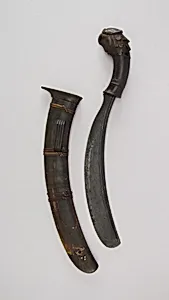
Sword with Scabbard
Unknown Artist
18th–19th century
Medium
Wood, horn
Dimensions
H. with sheath 17 in. (43.2 cm); H. without sheath 16 7/16 in. (41.8 cm); H. of blade 11 3/4 in. (29.8 cm); W. 3 in. (7.6 cm); Wt. 1 lb. 0.6 oz. (470.6 g); Wt. of sheath 5.8 oz. (164.4 g)
Classification
Swords
Culture
Bornean
Department
Arms and Armor
Museum
Metropolitan Museum of Art, New York, NY
Credit
Bequest of George C. Stone, 1935
Accession Number
36.25.1442a, b
Rights
Public Domain
Art Historical Context
This exquisite *Sword with Scabbard from Borneo, dating to the 18th–19th century, showcases the masterful craftsmanship of an unknown artist working with humble yet durable local materials: wood and horn Measuring 17 inches (43.2 cm) with its sheath and weighing just over a pound (470.6 g) unsheathed, this weapon balances functionality with artistry. The hilt and scabbard, likely intricately carved from wood and horn, highlight the resourcefulness of Bornean makers, who transformed natural elements into tools of both war and status. Housed in the Metropolitan Museum of Art's Arms and Armor Department, this sword reflects the martial traditions of Bornean cultures on the island of Borneo in Southeast Asia. During this period, such blades were essential for headhunting raids, defense, and ceremonial displays among indigenous groups, embodying a warrior ethos. The use of organic materials like horn—prized for its strength and workability—underscores sustainable techniques passed down through generations, blending utility with subtle aesthetic appeal. Bequeathed by George C. Stone in 1935, this piece invites visitors to ponder the artistry hidden in everyday objects of survival. Though its exact provenance remains mysterious, it stands as a tangible link to Borneo's vibrant, resilient heritage.