
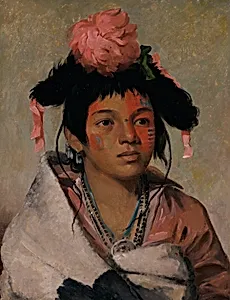
Tcha-káuk-o-ko-máugh, Great Chief, a Boy
1831
Medium
Painting
Classification
Painting
Department
Smithsonian Collection
Museum
Smithsonian American Art Museum
Credit
Smithsonian American Art Museum, Gift of Mrs. Joseph Harrison, Jr.
Accession Number
1985.66.225
Rights
Public Domain
Tags
About this artwork
“This tribe [Menominee] living out of the reach of buffaloes, cover themselves with blankets, instead of robes, and wear a profusion of beads and wampum, and other trinkets.” George Catlin probably executed this portrait in Washington in1831. (Catlin, Letters and Notes, vol. 2, no. 52, 1841; reprint 1973)
Art Historical Context
George Catlin's *Tcha-káuk-o-ko-máugh, Great Chief, a Boy* (1831) captures the dignified likeness of a young Menominee leader, showcasing the artist's lifelong passion for documenting Native American life. Painted likely in Washington, D.C this oil portrait reflects Catlin's mission to preserve the portraits and customs of Indigenous peoples before they were altered by Western expansion. As a pioneering 19th-century artist, Catlin traveled extensively the American West, creating over 600 works that form a vital visual record of tribes like the Menominee. The Menominee, from the Great Lakes region beyond buffalo territory, adorned themselves with vibrant blankets, beads, wampum, and trinkets rather than hides—a detail Catlin noted vividly in his *Letters and Notes* (1841). This painting highlights the boy's status as a "Great Chief," emphasizing cultural pride through his regalia and poised expression. Catlin's realistic style, blending ethnographic accuracy with Romantic idealism, underscores the humanity and nobility of his subjects amid encroaching U.S. policies of removal. Housed in the Smithsonian American Art Museum (gift of Mrs. Joseph Harrison, Jr.), this work invites visitors to reflect on Indigenous resilience and the irreplaceable value of Catlin's archive in understanding pre-colonial Native identities.
About the Artist
George Catlin · 1796–1872
George Catlin (1796–1872), born in Wilkes-Barre, Pennsylvania, to Putnam Catlin and Polly Sutton—who had been captured by Native Americans during the 1778 Battle of Wyoming—initially pursued a legal career. Trained at Litchfield Law School, he was admitted to the bar in 1819 but abandoned law after two years to study art in Philadelphia in 1823. Self-taught as a portraitist, Catlin quickly gained ...