
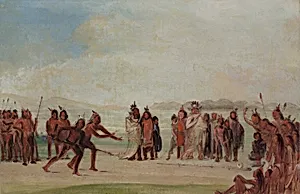
Tchung-kee, a Mandan Game Played with a Ring and Pole
1832-1833
Medium
Painting
Classification
Painting
Department
Smithsonian Collection
Museum
Smithsonian American Art Museum
Credit
Smithsonian American Art Museum, Gift of Mrs. Joseph Harrison, Jr.
Accession Number
1985.66.431
Rights
Public Domain
Tags
About this artwork
“The game of Tchung-kee [is] a beautiful athletic exercise, which [the Mandan] seem to be almost unceasingly practicing whilst the weather is fair, and they have nothing else of moment to demand their attention. This game is decidedly their favourite amusement, and is played near to the village on a pavement of clay, which has been used for that purpose until it has become as smooth and hard as a floor . . . The play commences with two (one from each party), who start off upon a trot, abreast of...
Art Historical Context
George Catlin's *Tchung-kee, a Mandan Game Played with Ring and Pole* (2–1833) vividly captures a dynamic moment in Mandan village life along the Upper Missouri River. As a pioneering 19th-century American artist, Catlin immersed himself among Plains tribes, creating realistic oil paintings that served as ethnographic records. His style—precise, observational, and unromanticized—aimed to preserve Native cultures amid rapid change from Euro-American expansion. This work, now in the Smithsonian American Art Museum showcases athletic Mandan men in action, their bare torsos and focused expressions conveying the game's intensity. The painting illustrates *tchung-kee*, the Mandans' beloved outdoor pastime played on a smooth, clay-hardened pavement near their village. As Catlin described in his 1841 *Letters and Notes*, competitors trot forward while one rolls a small stone ring (2–3 inches across); each then hurls a six-foot pole adorned with leather projections, sliding it to hook the ring when it halts. Sketched during Catlin's 1832 visit, the scene highlights the tribe's physical prowess and communal spirit during fair weather. Culturally, *tchung-kee* reflects Mandan traditions of skill and recreation, akin to hoop-and-pole games widespread among Plains peoples. Catlin's artwork holds enduring significance as a rare, firsthand visual archive, offering museum visitors a window into a pre-contact world rich in vitality and ingenuity.
About the Artist
George Catlin · 1796–1872
George Catlin (1796–1872), born in Wilkes-Barre, Pennsylvania, to Putnam Catlin and Polly Sutton—who had been captured by Native Americans during the 1778 Battle of Wyoming—initially pursued a legal career. Trained at Litchfield Law School, he was admitted to the bar in 1819 but abandoned law after two years to study art in Philadelphia in 1823. Self-taught as a portraitist, Catlin quickly gained ...