
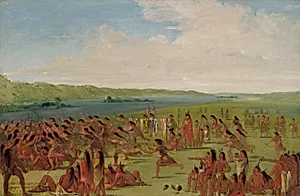
Ball-play of the Women, Prairie du Chien
1835-1836
Medium
Painting
Classification
Painting
Department
Smithsonian Collection
Museum
Smithsonian American Art Museum
Credit
Smithsonian American Art Museum, Gift of Mrs. Joseph Harrison, Jr.
Accession Number
1985.66.430
Rights
Public Domain
Tags
About this artwork
George Catlin witnessed Choctaw lacrosse in Indian Territory in 1834, but a year later, at Prairie du Chien in today’s Wisconsin, Catlin saw and recorded the Eastern Sioux/Dakota version of ball-play. He later described the game: “In the ball-play of the women, they have two balls attached to the ends of a string, about a foot and a half long; and each woman has a short stick in each hand, on which she catches the string with the two balls, and throws them, endeavoring to force them over the goa...
Art Historical Context
George Catlin's *Ball-play of the Women Prairie du Chien* (1835–1836) captures a dynamic moment in Native American life during his extensive travels across the American frontier A pioneering artist and ethnographer, Catlin dedicated much of his career to documenting cultures threatened by westward expansion. Painted after he observed the Eastern Sioux (Dakota) women at Prairie du Chien—a key fur-trading hub in present-day Wisconsin—this oil painting vividly records a traditional game distinct from the Choctaw lacrosse he had seen the previous year in Indian Territory. In Catlin's own words from his 1841 *Letters and Notes*, the women used "two balls attached to the ends of a string, about a foot and a half long," wielded with short sticks in each hand to hurl them toward their party's goal. This energetic sport fostered community bonds and physical prowess among Dakota women, highlighting gender-specific roles in tribal traditions. Catlin's realistic style, rooted in his commitment to accurate portraiture and scene-making, preserves these vanishing rituals for posterity. Housed in the Smithsonian American Art Museum, the painting offers a window into 19th-century Native resilience and cultural vibrancy, reminding visitors of the rich diversity Catlin sought to immortalize before it faded.
About the Artist
George Catlin · 1796–1872
George Catlin (1796–1872), born in Wilkes-Barre, Pennsylvania, to Putnam Catlin and Polly Sutton—who had been captured by Native Americans during the 1778 Battle of Wyoming—initially pursued a legal career. Trained at Litchfield Law School, he was admitted to the bar in 1819 but abandoned law after two years to study art in Philadelphia in 1823. Self-taught as a portraitist, Catlin quickly gained ...