
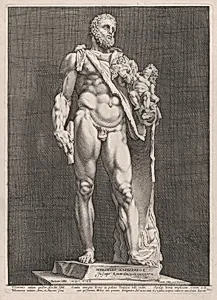
The Emperor Commodus as Hercules
Medium
Engraving
Dimensions
Sheet: 19 11/16 × 14 1/2 in. (50 × 36.8 cm)
Classification
Prints
Department
Drawings and Prints
Museum
Metropolitan Museum of Art, New York, NY
Credit
Bequest of Herbert Mitchell, 2008
Accession Number
2018.839.110
Rights
Public Domain
Tags
Art Historical Context
In the late 16th century, engraver Hendrick Goltzius captured the grandeur of Rome in *The Emperor Commodus as* (1592), a engraving now housed in the Metropolitan Museum of Art's Department of Drawings and Prints. nearly 20 by 14 inches, this large sheet exemplifies Goltzius's mastery of the medium, where intricate lines etched into a metal plate create rich tonal depth and sculptural form, rivaling the illusion of painted or carved figures. The image portrays Roman Emperor Commodus (r. 180–192 CE), who famously styled himself as the demigod Hercules, donning the hero's signature lion skin and wielding his club amid classical motifs. This Renaissance print reflects the era's fascination with antiquity, blending historical portraiture with mythological idealization to celebrate imperial power and physical prowess—evident in the muscular male nude that dominates the composition. Goltzius, a leading Mannerist artist, pushed engraving's technical boundaries with his bold, swelling lines, making this work both a technical marvel and a cultural bridge between ancient Rome and Northern Europe's print revolution. A bequest from Herbert Mitchell in 2008 preserves this testament to human ambition and artistic virtuosity for modern visitors.
About the Artist
Hendrick Goltzius · 1558–1617
Hendrick Goltzius (1558–1617) was the most celebrated engraver of the Northern Renaissance and a pivotal figure in Dutch Mannerism. Born near the German-Dutch border, Goltzius transformed printmaking into a virtuoso art form through his revolutionary 'swelling line' technique, where the burin was manipulated to create lines of varying thickness that produced unprecedented tonal effects and three-d...