
Tile Panel
Unknown Artist
ca. 1430
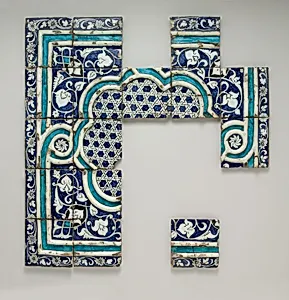
Medium
Stonepaste; modeled, polychrome painted under transparent glaze
Dimensions
H. 45 in. (114.3 cm) W. 45 in. (114.3 cm)
Classification
Ceramics-Tiles
Department
Islamic Art
Museum
Metropolitan Museum of Art, New York, NY
Credit
Gift of Professor Maan Z. Madina and Dr. Marilyn Jenkins-Madina, 2009
Accession Number
2009.59.2a–p
Rights
Public Domain
Art Historical Context
Welcome to the Islamic Art galleries, where this stunning **Tile Panel** (ca. 1430) transports us to the vibrant world of medieval Islamic architecture. Crafted by an unknown artist from stonepaste—a fine, white-bodied ceramic material prized for its ability to mimic porcelain—this square panel measures an impressive 45 by 45 inches. Its surface features modeled relief elements and polychrome paints fired under a transparent glaze, luminous colors and intricate designs that would have adorned mosques, palaces, or madrasas. Stonepaste, developed in the 10th century across the Islamic world from Iraq to Syria and Persia, allowed artisans to produce durable, high-relief tiles resistant to wear in humid climates. By the 15th century, during the Mamluk era in Egypt and Syria, such panels often depicted floral motifs, arabesques, or geometric patterns symbolizing paradise gardens—a nod to spiritual harmony and the infinite beauty of creation. Generously gifted to the Metropolitan Museum of Art in 2009 by Professor Maan Z. Madina and Dr. Marilyn Jenkins-Madina, this panel exemplifies the technical mastery and aesthetic splendor of Islamic ceramics. Imagine it gleaming under lantern light in a grand hall, inviting contemplation of artistry that bridged East and West.