
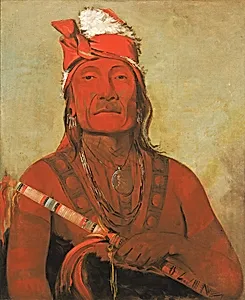
Toh-kí-e-to, Stone With Horns, a Chief
1832
Medium
Painting
Classification
Painting
Department
Smithsonian Collection
Museum
Smithsonian American Art Museum
Credit
Smithsonian American Art Museum, Gift of Mrs. Joseph Harrison, Jr.
Accession Number
1985.66.82
Rights
Public Domain
Tags
About this artwork
George Catlin painted Stone with Horns at Fort Pierre, on his Missouri River trip in 1832. Stone with Horns was a chief of the Yankton Nakota, and Catlin described him in his travel account, Letters and Notes: “Toh-ki-e-to . . . [is] reputed the principal and most eloquent orator of the nation. The neck, and breast, and shoulders of this man, were curiously tattooed, by pricking in gunpowder and vermilion, which in this extraordinary instance, was put on in such elaborate profusion as to appear ...
Art Historical Context
In 1832, George Catlin captured the commanding presence of Toh-kí-to, known as Stone With Horns, a of the Yankton Nakota (a Dakota Sioux band), during his expedition up the Missouri River to Fort Pierre. Catlin, a pioneering American artist dedicated to documenting Native American life before widespread cultural disruption, painted this portrait as part of his ambitious project to create an ethnographic record of Indigenous peoples. His realistic style, emphasizing authentic details of dress and adornment, reflects the Romantic era's fascination with the "noble savage" while serving as vital historical testimony. The painting vividly portrays the chief's elaborate tattoos—pricked with gunpowder and vermilion across his neck, breast, and shoulders—creating an effect like a richly embroidered garment from afar. Stone With Horns holds a long-stemmed pipe wrapped in porcupine quills, draped in a prized grizzly bear robe, and adorned with wampum strands, symbols of status and prowess. Catlin amusingly noted the chief's vanity, as he boasted through an interpreter about his oratorical feats during the sitting, revealing a charismatic leader brimming with self-assurance. This work, now in the Smithsonian American Art Museum, underscores the cultural richness of Plains tribes and Catlin's role in preserving their images amid encroaching settlement, offering visitors a window into a vibrant era of Native leadership and artistry.
About the Artist
George Catlin · 1796–1872
George Catlin (1796–1872), born in Wilkes-Barre, Pennsylvania, to Putnam Catlin and Polly Sutton—who had been captured by Native Americans during the 1778 Battle of Wyoming—initially pursued a legal career. Trained at Litchfield Law School, he was admitted to the bar in 1819 but abandoned law after two years to study art in Philadelphia in 1823. Self-taught as a portraitist, Catlin quickly gained ...